






Introduction to 'The Transatlantic Trade and its impact on Britain'


A c19th defender of the British Empire would claim that it was different from all other empires because the British Empire was an empire of freedom, both commercial and political, and an empire in which the British sought to improve the quality of civilisation for its inhabitants. Such a claim would not have been possible without the abolition of the slave trade and slavery, which according to its defenders gave Britain the moral authority to ‘civilise’ its territories. To support the claim that the empire was based on an ideology of developing commerce, civilisation and Christianity, historians for over a hundred years following the abolition of slavery in 1833 explained the abolition of slavery as being the result of the campaign organised by Thomas Clarkson and others. That view said little about Britain’s role in expanding the slave trade in the c18th and the brutality of that trade. Kevin Shellington wrote in History Today March 2007, that ‘a historical narrative developed that glossed over Britain’s determining role in the growth of the slave trade during the seventeenth and eighteenth centuries, and focused instead on the campaign to eradicate the trade and the British as the great emancipators of the age.’
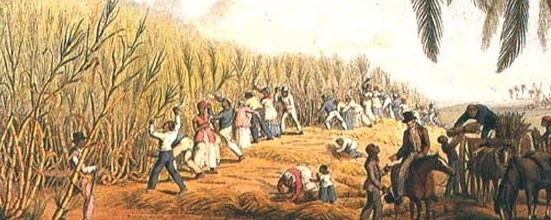
The focus on the ‘heroic emancipators’ was challenged in 1944 when Eric Williams, a Trinidadian historian, in his book, Capitalism and Slavery, argued that the prime motivation for the abolition for the slave trade was economic as the West Indian plantations were no longer economically viable, and financiers were now looking towards investing in the factories of the developing Industrial Revolution, and lobbying for free trade and labour to minimise their costs. Since 1944 other historians have challenged and refined Williams’ arguments, claiming that there were plantations in the West Indies that were still profitable and that the West Indies lobby was still extremely powerful in the British parliament. In Legacies of British Slave Ownership by Hall, Draper, McClelland, Donnington and Lang, the introduction to this book that arose out of the UCL Project, states that Williams did not argue that slavery caused the Industrial Revolution and was solely and entirely responsible for the economic development.
The extent to which the debate about the abolition of the slave trade and slavery in the empire, had moved on could be seen in March 2007, the 200th anniversary of abolition of the slave trade, when a number of articles appeared in History Today and The Historian. In an article in The Historian Spring 2007, James Walvin author of many books on the British and slavery, wrote a detailed piece on the causes of abolition. The campaigns of the Quakers on both sides of the Atlantic were crucial to him, and particularly the crusading work of Thomas Clarkson which mobilised hundreds of thousands. Walvin makes it clear that it was the public campaign organised by Clarkson that motivated people to believe that there was something inherently wrong about the slave trade and that it was this changing of the British view that was crucial to abolition. Walvin also makes it clear that resistance from slaves, particularly in the French colony of St Domingue, had a huge impact on the government. Another factor in bringing about abolition mentioned by Walvin was the change in government in 1806. Pitt died in 1806 and in the ensuing General Election, a number of new MPS were elected together with a new government led by Grenville, who despite only having a small majority, was determined to bring about abolition of a trade that was in the words of Fox contrary to the principles of justice,[and] humanity. Walvin leaves open the question of what was the determinant factor in bringing about abolition: a change in the minds of the British people, slave resistance, the economic viability of the plantations or the work of Clarkson and Wilberforce?
In recent years, there has been a number of new approaches to the study of slavery and the role of the British, much of it according to David Cannadine in his book Ornamentalism, published in 2001, stimulated by work on gender and race, culture and language. Since much of it is being undertaken by literary scholars rather than by historians, it may be loosely labelled ‘post-modern’ or ‘post-colonial’.
Williams’ contention that the slave trade was central to the development of industrialisation in Britain has also been challenged. C.K.Harley, an economic historian wrote in 2015 in The Caribbean and the Atlantic World Economy Americanisation transformed Britain’s trade in the c18th and that the diversification of British exports away from Europe depended on the Atlantic economy of which the slave economies were an important part. However, he claims that it is impossible to say that the sugar economy in the West indies was the most important factor in the Atlantic trade. The Atlantic trade was a complex network of business interests which included the sugar trade but also included the trade with the North American colonies. It is clear that debate about the links of the sugar trade with Britain and the industrialisation of the late c18th will continue.
The extent to which slave ownership permeated British society, and the involvement of absentee slave owners in the commercial and industrial life of British has been exposed by a project conducted by the University of London, The Legacies of British Slave-Ownership, which has analysed the claims for compensation made during the 1830s following the abolition of slavery in the British Empire. The UCL project has created a data base of 47,000 individuals, most of whom were named in claims made for compensation. Using this database, which the public has access to, it is possible to see to what extent slave owners were a part of British society, and where they lived. The database gives details on who received compensation and how much but it is not possible to follow the money and determine how such money was used. The database will no doubt encourage many to research the impact of the slave trade on their own community. The database though must be used carefully otherwise it is quite easy to come to a false understanding of the real impact of slavery.