





Louis Riel
Louis Riel
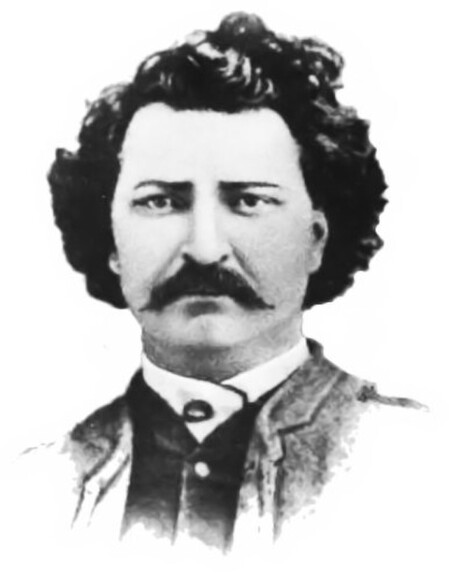
Louis Riel was a leader of the Métis people who in 1869-1870 rose up against the transfer of Metis land from the Hudson’s Bay Company to the Dominion of Canada. Riel emerged as the leader of the Métis, who were particularly worried about the expected arrival of a large number of English-speaking settlers, following the recent creation of the Confederation of Canada in 1867 and the subsequent impact that would have on the culture of the Métis.
Riel was born on October 23, 1844 in St Boniface, Assiniboia, North West Territories, Canada. He was the oldest of 11 children born to Julie Lagimoniere and Louis Riel, a local Métis leader who supported opposition to the trade monopoly enjoyed by the Hudson’s Bay Company (HBC). Riel studied for the priesthood in Montreal, although he was never ordained. Instead, he worked at a number of different jobs until he decided to return to Red River in the late 1860s.
The Red River Colony, located at the confluence of the Red and Assiniboine Rivers, had been a trading base for the fur trade for many years with the HBC establishing a depot in St Boniface and the North West Company establishing Fort Gibraltar in 1809. The area was the home for Ojibwe, Cree traders and Métis buffalo hunters who were the descendants of French and English hunter-trappers. By the beginning of the c19th the Métis were an indigenous people with a distinct culture derived from their mixed European and indigenous parentage. The Red River colony had originally been populated with Scottish settlers and founded by Thomas Douglas, Earl of Selkirk, in 1812 in response to the Highland clearances. After 1836 the colony was administered by the HBC, by which time it was mainly occupied by Métis people who were in constant arguments with the HBC about trading privileges and the threats to their religion, land rights and culture. Following a survey in August 1869 of the Métis land and the purchase by the Canadian Government of the former Rupert’s Land in 1870, little attempt was made by the Canadian government to recognise the concerns of the Métis about the possible loss of their farms which might follow increased settlement by British settlers.

Old Fort Garry
The November 1869 uprising
When William McDougall, a known Canadian expansionist was appointed as the first Lieutenant-Governor of this new territory, feelings ran high amongst the Métis. Louis Riel became the spokesman of the local people, with support from both the English and French speaking communities. In November 1869, Riel led a group that prevented McDougall and a land surveying group from entering the colony and the assumption of control by the Canadian Government of the colony had to be postponed. Fort Garry, the administrative centre of the Red River colony and a former HBC trading post sited in present day Winnipeg, was occupied and in January 1870 a provisional government was established with Riel as president, to enter into discussions with the federal government in Ottawa regarding terms for formal annexation. The Government recognised the rights of the Red River settlers and on 12 May a new province, Manitoba, was created by the Manitoba Act by which there was agreement on a bi-lingual provincial government and for 1.4 acres of land to be set aside for Métis offspring.
During the time of the uprising the provincial government court-martialled and executed Thomas Scott, an English-speaking settler from Ontario, because he had been strongly opposed to the uprising. Scott’s death was used to stir up opposition to the new province in Ontario and in April 1870 Garnet Wolseley was ordered to lead a British and Canadian expeditionary force to put down the insurrection at Fort Garry. When Wolseley arrived at Fort Garry in August 1870 Riel had left with his followers and gone into exile to the USA. Riel was offered no amnesty by the Ottawa government, however a year later he returned to Red River and was elected to the House of Commons from the Manitoba district of Provencher in a by-election in 1873 but did not take his seat. He was elected on two further occasions, but his opponents ensured that he was expelled on both occasions. In February 1875 Riel was granted an amnesty by the Canadian government for his part in the Red River uprising in 1870, on condition that he accept a five year ban from entering the provinces.
The resistance of the Métis people had won some major concessions on land rights and the reserving of land for their children but these arrangements were mismanaged by later federal governments and it was not long before the Métis began to move out of Manitoba and moved further west, to present day Saskatchewan, however this area had also been acquired by Canada and became part of the Northwest Territories. The Canadian government entered into a number of treaties with the indigenous people of the area but not with the Métis.
After Riel left the Red River area, he settled in Montana where he married and started a family and found a new religious zeal and believed he had had a vision in which he was called to become a prophet for the Métis, who he believed were a people favoured by God. He joined the Republican party and worked with local French and English-speaking community leaders as well as leaders of the Cree tribe, to reduce the trade in whisky that was having such a negative impact on local people.
A death sentence
In 1884, Riel accepted a request to help the Metis of the Saskatchewan Valley to help settle their grievances with the Canadian government. The Canadian authorities were refusing to listen to the concerns and grievances of the Métis, particularly concerning their land rights. Riel returned to Canada and helped to establish a provisional government (in March 1885).
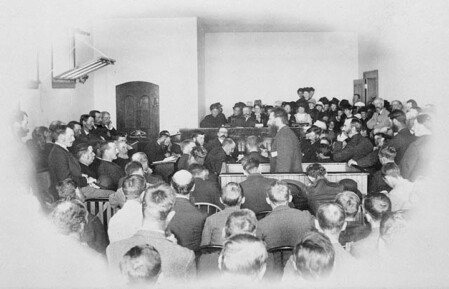
The trial of Louis Riel
There were a number of skirmishes until a larger force of militia crushed the rebellion at the Saskatchewan capital of Batoche and Riel surrendered on May 15. Riel was tried in Regina for high treason and he used the occasion as an opportunity to outline the injustices suffered by the Métis people over time. The jury found Riel guilty and recommended clemency, only for the judge to deliver a death sentence. Despite one doctor subsequently finding that Riel was unable to differentiate between right and wrong, he was hanged in Regina on November 16, 1885.
Resistance or Rebellion?
Riel’s death provoked outrage in parts of Quebec and Ontario and helped to strengthen French Canadian nationalistic opposition to the federal government. He will be remembered for his defence of the rights of the Métis people and the creation of present day Manitoba. his execution had a lasting effect on Canadian politics polarizing views along ethnic lines but his death and the failure of his rebellions ensured the Prairie provinces would be dominated by the Anglophones rather than by the Francophones. He has been seen as a religious fanatic on the one hand and also a rebel against the Canadian nation but in recent times is seen as a proponent of multiculturalism and Métis nationalism, and as a heroic rebel who fought to protect his heritage. Debates continue about the nature of the uprisings he led: were they acts of resistance or rebellions? Resistance can be defined as resisting a government that has been imposed by a foreign power e.g. the French Resistance in the Second World War whilst a rebellion is an organised armed resistance against an established and legal government.
When Riel took part in the seizure of Fort Garry from the HBC in November 1869 and the subsequent establishment of a provisional government that entered into discussions with the federal government, Rupert’s Land had not been bought by the Canadian government from the HBC. The Red River colony was being administered by the HBC and the taking of Fort Garry could be considered a rebellion against the HBC but not against the Canadian authorities. By 1885, at the time of his trial for high Treason, Canada had acquired the Northwest territories.
By Peter Crowhurst, June 2024
Further reading:
The North-West is our Mother, Jean Teillet, Harper Collins 2019.