





The Development of the Atlantic Slave Trade
A new trading system
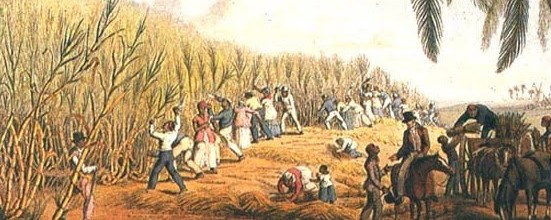
The Atlantic Slave Trade developed over more than two hundred years. In the two hundred years between 1600 and 1800, a new, vast and hugely complex trading system was established between Europe, Africa and the Americas which led to over twelve million Africans being enslaved and used as labour for the plantations which produced sugar, tobacco and rum for the newly established European consumer market. Of the twelve million Africans who were caught by African traders and sold to European ships, over three million travelled in British ships as Britain came to dominate this trade by the mid-18th century. There were over 11,000 British slave voyages in the c18th and of these more than half sailed from Liverpool.
Slavery was part of the culture
Slavery had existed for centuries throughout the classical and medieval world, and indeed was part of the culture of many African tribes, but the brutality and inhumanity exerted on the enslaved Africans on the passage to America and then the miserable living and working conditions on the plantations, has attracted the attention of historians who have focused on this episode in the history of slavery. The Atlantic Trading system that developed out of the needs of the American colonies and the plantations in the thirteen American colonies and the West Indies dominated global trade and was a huge influence on the development of those countries that were part of that trading system. It was demand for sugar in Britain in particular that drove the continual demand for African enslaved labour, and it was Britain that was most affected by this Atlantic trading system. By 1800 sugar was consumed by all classes and the ports of entry were made wealthy by the trade, but there was not a person in Britain who did not benefit from the trade in some way.
The modern debate around the slave trade has focused
on Britain’s role because of the numbers forcibly taken from Africa to provide
labour for the sugar plantations and the horrific conditions in which they were
transported and then worked. However, slavery had existed for many centuries
before the British began to use slavery in the c18th. Slavery thrived throughout
the empires of Ancient Egypt, Greece,
and Rome, and then spread as Islam expanded.
The Romans used slaves as the basis for their armies
and for industrial and agricultural work. It is thought that at the height of
the Roman Empire, military successes provided half a million slaves a year.
James Walvin calculates that up to 35% of the population of Athens were
enslaved and up to 33% of the population of Rome.
Slaves from the south of the Sahara
The Islamic states of North Africa used slaves to work
the fields, to manage homes and to fight in their armies. The Koran forbade the
use of Muslim slaves, so slaves were procured from the African states south of
the Sahara, where slavery flourished. Strong rulers used prisoners captured in
war as slaves who eventually were integrated into society. Strong rulers also
demanded slave labour from weaker neighbours.
Slavery flourished in Europe in the Middle Ages and
was an essential part of Christian society. It only really declined with the
development of feudalism when slaves often became landless serfs although
slavery continued to be an important part of Iberian society with both
Christians and Muslims in Spain raiding each other’s communities for slaves. In
the mid-c13th Barcelona rivalled Majorca as a major slave trading centre. As
late as 1500 the trade in slaves thrived in the Mediterranean, with Spain
taking slaves from North Africa, Turkey, and central Asia.
Elmina Castle
Europeans arrive in west Africa
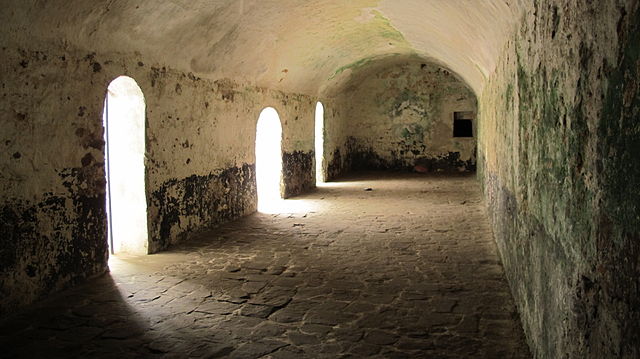
When Europeans arrived in West Africa at the end of the c15th, they found an existing trade in slaves, but the Atlantic trade introduced by Europeans exceeded the existing trade in its brutality and inhumanity. The Portuguese were the first to arrive in West Africa, using Cueta in Morocco as a base from which they traded. In the 1430s and 1440s they moved further and further south, finding new African trade routes. Initially these ships used violence to acquire the slaves they brought back but by the mid-c15th the Portuguese had established a base on Arguin Island where they accumulated slaves they bought from Berber merchants. By 1460 the Portuguese had reached Senegambia where they exchanged slaves for horses. In 1471 the Portuguese established a fortress (Elmina) on the Gold Coast of modern day Ghana from where slaves were sold to the local Akan chieftains to work in the gold mines. In the mid-1490s the Portuguese established a colony on the island of Sao Tome in the Gulf of Guinea to collect slaves from Benin, the Congo and Angola. These slaves were then sent to Elmina where they were exchanged for gold. The rich volcanic soil on Sao Tome was ideal for the cultivation of sugar and the plantations established on the island became the model for future plantations in the Americas. When the Portuguese established sugar plantations in Brazil in the 1530s they used African labour brought from Sao Tome.
Sao Tome was just one of a number of islands – the
Canaries and Cape Verde islands were others- where European settlers and
African slaves cultivated sugar cane, a product that had long existed in Europe
but only now began to become popular as something exotic for the wealthy
European elites.
An increasing demand for slaves
The increasing numbers of slaves being taken by the
Portuguese began to concern African rulers. Then kingdom of Benin refused to
sell any more slaves to the Portuguese, and other chiefs began to express their
concerns about the depopulation that was taking place, but the Portuguese were
able to play one chief off against another. The demand for enslaved labour for
these new Atlantic plantations increased the demand for slave labour which
became a feature of the new plantations. As the Portuguese established new
trading systems along the African coast, demand for slaves increased although
this was as nothing compared to the demand that would arise out of the
development of the Americas and the West Indies for the production of sugar,
rum and tobacco.
White indentured servants could not cope with the conditions in the Caribbean
Native people wre unsuitable for the work
When the Portuguese and Spanish began to colonise
South America in the early c16th, and develop gold mines and agriculture, the
native people proved to be unsuitable for the work required. Both the Spanish
and the Portuguese were used to trading for slaves and using slave labour and
it was not difficult to import African slaves for use in the plantations. In
1513 the Spanish Crown formally licensed the Portuguese to transport African
slaves, and with sugar plantations becoming dependant on African slaves, demand
began to increase. By 1600 around 200,000 Africans had been shipped from West
Africa to Portuguese and Spanish plantations in the Americas.
With the demand for slave labour getting ever bigger,
it became more and more difficult to control the trade which had become a
thriving business by the early c17th. Merchants and privateers from other
countries wanted a share in the profits to be made and it was not long before
the British began to be involved.
The English began to be involved
William Towerson was the first Englishman to become
involved in the salve trade in 1555 and he made a second voyage the following
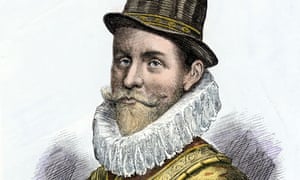
year. In 1562 John Hawkins sailed from Plymouth with three
ships to West Africa where he captured 300 Africans in Guinea before
transporting them across the Atlantic to sell them to Spanish colonists in the
Caribbean. The profits from the trip were so large that Elizabeth I herself
invested money in the expeditions which Hawkins made in 1564/65 and 1567/68. Although
such ventures were supported by the monarch, British involvement was limited as
access to the American market was difficult. Only when the British had
established colonies of their own would British involvement in the trade
increase. Once they began to play a part in the Atlantic trade, it would be absolutely
transformed.
Hawkins
After the initial voyages by Towerson and Hawkins,
English privateers realised there was more money to be made by preying on
Spanish fleets in the Caribbean. This
phase lasted until British settlement of Caribbean island began in the early
c17th with the occupation of St Kitts, (1624) and Barbados (1625). With Spanish
and Portuguese power in the region now waning and British merchants and seamen
acquiring the knowledge and experience of the slave trade, the British began to
develop West Indian islands for commercial gain.
Barbados was the first British slave colony
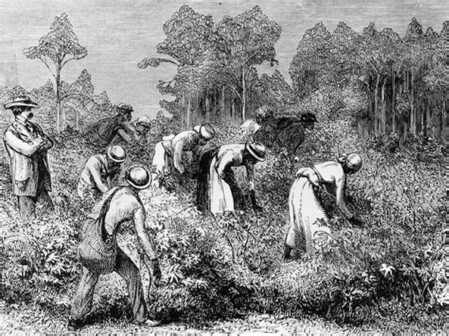
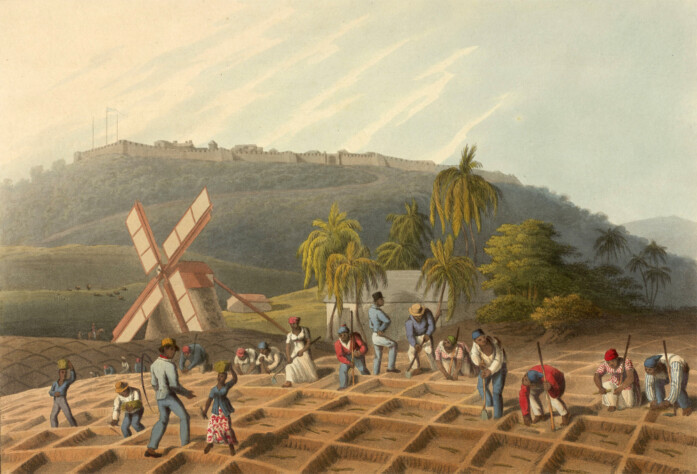
The early settlers in Barbados tried to develop a number of crops using native and European labour (indentured) but once sugar began to be grown the profits were so great that small plantations were merged with larger ones and a class of large plantation owners emerged. At first European indentured labour was sufficient but with the growth of the industry, and the failure of the Europeans to adapt to the climate, the plantation owners began to rely more and more on African slave labour so that by 1680 there were 38,000 slaves on the island whereas just fifty years earlier there had been just 5,680. By 1700 Barbados had 50,000 slaves working on its plantations and the main port Bridgetown was the busiest port in the Americas.
In 1655 Jamaica was taken from the Spanish. It was a much larger island than Barbados and had a more diverse landscape. The settlers there tried at first to grow a variety of crops but with sugar proving the most profitable, it became another sugar colony with 42,000 slaves in 1700. Fifty years later in 1750 the enslaved population stood at 118,000. As French colonies were added following the many wars between the two countries in the c18th so did these colonies turn to sugar production.
The situation in the American colonies was a little different to the Caribbean colonies. More indentured labour was used initially and even when these colonies turned increasingly to the production of tobacco, the slave population was self-sustaining as there was a natural increase unlike the slave populations on the islands where the death rate was so high that plantations had to rely on the purchase of slaves on a regular basis. As well as sugar and tobacco, rice was also grown, particularly in South Carolina, where there were 40,000 slaves by 1750.
Britain the dominant slave trading nation
Britain emerged as the dominant slave trading nation
by the beginning of the c18th. Controlling much of the trade between 1672 and
1713 was the Royal African Company which
had a state monopoly and by the time the company ended it had sent 120,000
slaves to the Caribbean, mainly from Sierra Leone, Senegambia, the Gold Coast
and the Bight of Benin.
British slaving ships
would embark on a three-stage voyage, leaving ports like Liverpool, Glasgow,
and Bristol laden with cloth, metal goods, guns, and alcohol to be traded for
African captives. Prospective slaves were taken prisoner by African traders and
brought to trading posts or forts to be exchanged for whatever cargo the slave
ships had brought with them. They were held in wooden forts or in the dungeons
of stone castles before being sold to the captains of the slave ships. The
slave ships which were designed particularly for the purpose of transporting
hundreds of Africans in dark, damp conditions, did not linger long at these
bases. British captains were in constant fear of being attacked whilst in port
or of their crew falling ill from one of the many West African diseases.
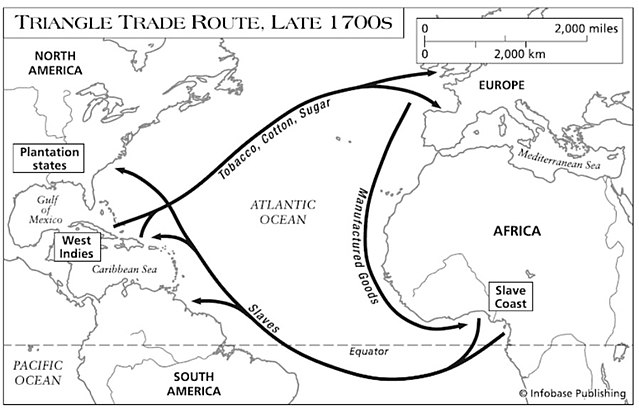
The Atlantic Trade routes
The middle passage
These slave ships then sailed for the Caribbean where
the enslaved were sold for a heavy profit. On board the slaves were kept in
manacles and chains and allowed on deck intermittently to be hosed down. Below
decks additional decks which resembled shelves accommodated the slaves who were
stacked in with little room to turn over in their sleep. The journey to the
Caribbean would last several months during which at least 20% of the human
cargo might die. Crews on board the slave ships were larger, in order to be
able to deal with any attempted rebellion, and these crew members were paid
more. Guns were sited on the quarter deck aimed at where the slaves stood when
above decks, and ready to deal with any insurrection. Those who died were
thrown overboard and there were many who decided that rather than suffer a life
of servitude they were better off throwing themselves overboard. Arriving in
the Caribbean ports, the slaves were handed over to agents who would arrange
their sale. The ships were then loaded with the products of slave labour, (sugar,
rum, and tobacco) and sailed for Britain. In the middle of the c18th a slave
could be bought in West Africa with goods worth £4-5 and then sold in the
Caribbean for £15-17. The cost of the passage was worked out as a further £5
resulting in approximately 30% profit.

After the Royal African Company
Following the demise of the Royal African Company,
British merchants established companies to trade on the so-called triangular
route. As the trade became more and more profitable, it became easier to obtain credit from banks that could be
assured of a good return on their loans.
Slave ships might have several owners or investors as the trade became one of
the most profitable ventures in business.
The British sweet tooth drove the demand for slaves
What drove demand for enslaved labour was the demand
for sugar which became a staple for British life by1800 so much so that Sir Frederick
Eden’s survey of the poor in the 1790s revealed that all classes, including the
poorest labouring classes had become addicted to sugar and the products it was
linked with - tea, coffee, jam, chocolate. Tea was drunk by poor families,
morning, noon, and night, to provide a ready and cheap source of energy when
the working man of the family would have potatoes.
Sugar was Britain’s main import until the development
of factories producing cotton goods in the early c19th, by which time cotton
had replaced sugar as the main import. What began as a luxury product in the
c17th sold by apothecaries as an apparent cure and remedy became like tobacco,
a product consumed in the taverns and coffee houses before it became a standard
ingredient for every household. Tea was central to sugar. Pepys is credited in
being one of the first to drink it in 1660 when very little was imported by the
East India Company but by 1720 around nine million pounds was being imported
into Britain, increasing to 37 million pounds by the middle of the c18th,
despite the duties imposed on tea. As the demand for tea increased in the c18th
so did the demand for porcelain, imported by the East India Company. The two
products together changed the nature of British society as tea drinking became
the centre of social life at all levels of society, but also were the basis of
a global trading system that linked China, India and the Atlantic. Although
imports of sugar from the Caribbean were not taxed, tea was, and the customs
duties paid provided a substantial element of the Exchequer’s income.

By the early c18th Britain dominated the trade in sugar and slaves and
by the end of the century, as the East India Company extended its influence in
India, Britain also dominated the trade
in tea and porcelain. The triangular trade was just a part of this global
trading network, dominated by Britain, that created huge amounts of wealth for
all those who were part of it and who had invested in it. The development of
the American colonies and the demand they created for manufactured goods from
Britain was an important element in the Atlantic economy which also had strong
links with South America and Asia
The Atlantic trade was key to Britain's industrial aand commercial development
This Atlantic economy was central to the development
of modern economic growth in Britain. As the American colonies developed they
required manufactured goods which were provided by Britain, in return for raw
materials. Britain’s economy diversified to meet this demand and was a key
factor leading to the industrial revolution of the late c18th. The American
colonies were colonies of settlement unlike the Caribbean colonies which
provided huge opportunities for exceptional profits however the northern
American colonies became important providers of maritime services in the form
of shipping and merchandising, to the Caribbean. Just as Britain became
dependant on the West Indies for sugar and tobacco, the American colonies
needed to sell timber, foodstuffs, and newly built ships to the Caribbean to
pay for the manufactured imports from Britain.

Slave ships in the port of Liverpool
Eric Williams changes the debate
Eric Williams in his 1944 book ‘Capitalism and
Slavery’ argued that the exceptional profits from the slave trade
lubricated the British economy and laid the basis for Britain’s industrial
revolution. It is certainly the case that the Caribbean plantations were
created to meet a demand for sugar from the British population and that the
stability of this trade gave bankers the confidence to lend money for further
investment in the system and for other entrepreneurs to invest in the
technology of the cotton industry. It was the development of the cotton
industry in the late c18th and early 19th that lay the foundations
for the development of the iron and coal industries, the basis of further
industrialisation in the c19th. Robin Blackburn in his book ‘The Making of
New World Slavery’ supports Williams’ thesis arguing that slave generated
profits could have covered a third of Britain’s overall investment needs. He
states that ‘around 1770 ‘total investments in the domestic British economy
stood at £4 million. This investment included the building of roads and canals,
wharves, and harbours, of all new equipment needed by farmers and
manufacturers, and of all the new ships sold to merchants in a period of one
year. Around the same time, slave-based planting and commercial profits came to
£3.8 million. Blackburn goes on to say that ‘Between 1761 and 1808
British traders hauled across the Atlantic 1,428,000 African captives and
pocketed £60 million from slave sales.’
Anyone wanting to set up a cotton mill and export
cotton goods required £1,000 to establish the mill but probably £10,000 for the
raw materials and labour needed to convert raw cotton to manufactured goods. It
might be a year before the owner saw any returns on this investment, so he
needed bankers who had the confidence to wait this long.
Whilst Williams’ book remains a seminal study, the
majority of scholars working on British industrialization are sceptical of
Williams’ claims. Whilst the demand for sugar was an important factor in
providing the profits that oiled early industrialization, the demand for
manufactured goods from the American colonies was also an important factor. The
reality is that the Atlantic Trading system was a series of interconnected
links that included trade between numerous countries including India, Brazil as
well as Britain and Britain’s Atlantic colonies. It was a global system that
included the Triangular Route, which was important to the industrial
development of Britain, but how important will continue to be the subject of
debate between historians for decades to come.
Related Pages