


The Secret of England's Greatness
by Thomas Jones Barker
<
>
This is
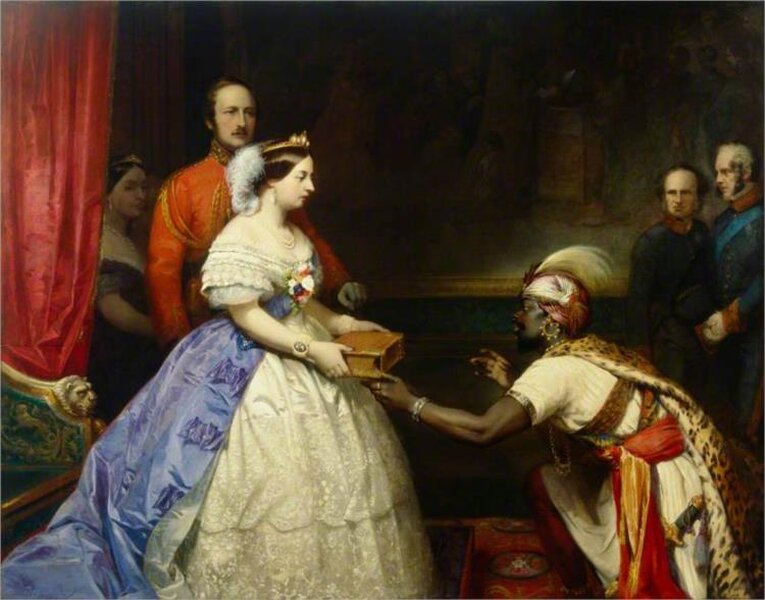
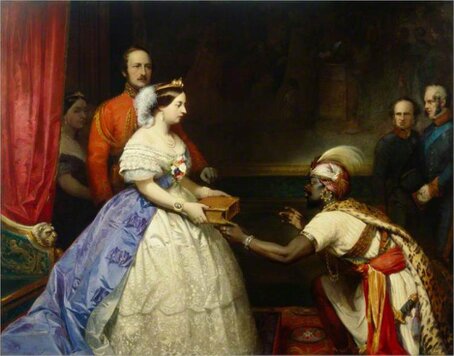
Barker’s most famous painting, an allegory of empire - of Britain’s mission to civilise. The scene, staged in the Audience Chamber at
Windsor depicts a scene set in the 1860s with Victoria at the centre presenting
a gift of a bible to an African prince who bows humbly in recognition of Victoria’s
power and position. Behind Victoria stands Prince Albert who himself is in front
of a women thought to be the Duchess of Wellington. Behind the prince stand
Lord John Russell, Foreign Minister, on the left and Lord Palmerston, Prime Minister.
The centre
of the painting is the bible, representing Christianity and a higher mystical
authority, a unifying religion, that brings the two cultures together. It is thought
that Barker got this idea from when an African envoy asked Victoria the source
of her power and instead of an answer which focused on the size of her nay and
army the Queen simply said ‘This is the secret of England’s greatness.’
In the book accompanying
the recent ‘Artist and Empire’ exhibition at the Tate, it is suggested that the
African prince in the painting may have been based on Ali bin Nasar, Governor
of Mombasa who attended Victoria’s coronation in 1838, on behalf of the Sultan
of Oman and the East African coast, Sayyid Sa’id. The sultan wanted to maintain
his control of trade3 along the east African coast at a time when the British
wanted to access markets and locate Christian missions in the area. Treaties
were negotiated in the 1840s and the Sultan did grant the Christian Missionary
Society the right to establish a base on Zanzibar. The attire of the prince was
that worn by the Omani rulers of the area although whether a Muslim would have
accepted a bible is doubtful.
The painting
shows the importance of diplomacy, monarch and Protestantism, and of Victoria
as pious. It was eventually shown at Jennings’s commercial gallery in 1863,
before it toured Ireland where it was acclaimed by the Protestant community for
showing the importance of their religion and the role of the bible in spreading
the word of God. After Ireland the painting toured the north of England until
it disappeared from view in 1866. The message of he painting was not universally
appreciated in the Empire and it was heavily criticised in Australia for
promoting religious motives for empire rather than economic motives.