





What was the Importance of Informal Empire?
A coherent entity?
At Victoria’s accession on June 22, 1837, the British Empire consisted of about two million square miles of territory and 100 million people. When she died in 1901 the Empire covered 121.8 million square miles and included over 400 million people covering one fifth of the world. There had been a huge expansion of territories and maps of this empire of over 60 dependencies could be seen in every classroom and government building giving the impression that the empire was a coherent political entity.
Nothing could be further from the truth. The different parts of the empire were governed in a variety of ways: some had an element of self-determination whilst others were governed by one man, a Governor, possibly but not always with an advisory group made up partly of local native officials. A third of India was still governed by native princes, who had negotiated treaties with the British which laid out guidelines by which they were to govern. The Empire had no single language, no one religion, and no one system of laws. The government of a colony could vary from the self-government in Canada to the despotic rule of many colonies. In some territories it was a private company that was given all the rights and responsibilities of government.
More trade with countries outside the empire
If an empire includes all those territories that have been
assimilated to the political and economic system of the mother country, then
the colonies of the British Empire could be considered to be just a small part
of that empire as there were many other territories that had an informal
arrangement with Britain but lay within Britain’s economic and political orbit. Britain had
more trade with countries outside the
empire than within it, and in fact Britain might well have done without
the formal empire and been economically better off.
There was a huge increase in the size of the British Empire
in the 19th century, but this was never part of any grand plan. The motives for
empire remained those of trade, religion and settlement throughout the empire,
and although missionaries, settlers and businessmen often sought the
intervention of government, the metropolitan government was always reluctant to
intervene to annex territory and impose a
British administration on a native people. The government ‘official
mind’ throughout the c19th was committed to support commerce, missionaries and
settlers but not necessarily to annex territory. When it did so it was always a
last resort. The government always preferred to achieve influence and perhaps
control though other means.

The British Empire in 1897
Dominance of the seas
The prevailing economic orthodoxy of the c18th had been mercantilism, a system which restricted commerce. Customs duties, import taxes and restrictions of shipping made it difficult for business trying to expand commerce. The ending of mercantilism at the beginning of the c19th and the adoption of Free Trade enabled businessmen to look for new markets and new sources of raw materials wherever they could find them. The phrase ‘Workshop of the World’ may have exaggerated the predominance Britain had, but by 1850 Britain prospered by manufacturing goods for sale abroad, which her customers paid for in raw materials and food. The taking away of artificial trade barriers together with the virtual monopoly of manufactured goods that Britain had after the Napoleonic Wars, meant her businessmen could look for profitable foreign markets with little or no foreign competition. British investors and entrepreneurs were no longer confined to the formal empire - they could seek out trade wherever in the world they could find it.
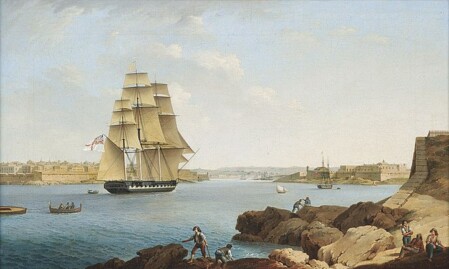
With their dominance of the seas, free trade benefitted the British. By the mid-1870s the Royal Navy consisted of more than 500 ships of which 61 were ironclads which no longer were dependant on the wind but were screw driven. The Royal Navy was more powerful than the next strongest navies combined. With such naval power it was possible to provide military support to
British financial and trading interest anywhere in the world.

The Royal Navy 1907
Free Trade
The dynamic provided by Free Trade encouraged settlers,
traders, financiers and missionaries to expand their interests wherever they
could, and with little resistance from other European states. This was a cheap
and efficient way of extending British influence. The British government was
happy to leave the extension of British influence to these groups although
there were times when the government was
prepared to intervene. The government expected the opportunities for trade to
be equally available to all businessmen. It expected British businessmen to
have access to all port facilities without any discrimination and there to be
no hindrance to free trade. It was hoped that free trade could take place
without formal agreements being made but if necessary the British government
was always willing to negotiate trade agreements or if necessary impose a
treaty by force or the threat of force.
With the freedom given to traders to operate freely the
volume of Britain’s overseas trade expanded steadily from 1850. The largest
markets were Europe and the USA which together accounted for two thirds of
exports in 1827, a trend which continued for the remainder of the century. In
1867 when Britain’s exports amounted to £181 million, the empire accounted for
just £50 million. The greatest expansion was in South America where in 1867
Argentina, Brazil, Chile and Peru imported products worth just over £12
million. There were even free traders calling for the end of political links
with the colonies of the empire although India by the end of the century
provided a market for British manufactured goods that was as important as the
US market. In 1867 India imported goods worth £21 million.
Britain’s export trade was dominated by staple goods like
manufactured cotton and woollen cloth and coal, railway track and steam engines
but increasingly the export of capital became crucial to a positive Balance of
Payments. The profits from agriculture and industry were invested in foreign and imperial investments rather than
in improving domestic consumption. By 1870 £50 million was being invested overseas and continued to grow as investors
put their money in stocks and shares. London became the hub of international
finance and the world’s exporter of finance, much of it to the ‘informal
empire’.

Decisions whether the government should intervene or not to protect British interestsoverseas often depended on the geopolitical situation and the likelihood of military success. In the eastern hemisphere, Britain had strong links with the USA and much of Latin America, but the possibilities for any kind of military intervention to maintain British interests were limited. Britain put a lot of pressure on the countries of Laine America to adopt free trade, but diplomatic efforts were not very successful. When Peru was persuaded to adopt free trade its government retained a state monopoly of its main export, guano, despite British and French opposition. Similarly, Britain was able to exert little pressure on Argentina and Uruguay. Britain was though successful in persuading Brazil to abandon the slave trade but could not prevent Brazil adopting tariffs in 1844. No British government would have contemplated the occupation or annexation of Latin America especially after the Monroe Doctrine of 1823.
Britain was more willing to intervene in the east as shown by British policy towards China and the opium trade. When the Chinese Empire attempted to stop the trade in opium in 1838, by boarding British ships and seizing cargoes of opium, and then blockading British merchants in their factories, the British sent a large force from India and seized Canton and Hong Kong. The Chinese were forced to accept the Treaty of Nanking and allow four treaty ports to open for free trade with the west. When the Chinese decided not to comply with these impositions a combined French-British force was sent, in 1860, to occupy Beijing. China was forced to open up ten more treaty ports, pay a large indemnity and agree to the opium trade continuing.
West Africa was regarded as a white-man’s grave, an inhospitable area with a deadly combination of humidity, heat and disease that meant British officials spent no more than twelve months at a time there. Britain had no interest in acquiring land but the need for palm oil meant that the Gold Coast was ruled directly from 1842 and when the Asante threatened trade between British traders and coastal tribes, Wolseley was sent with an army to subdue the Asante and force them to sign a treaty guaranteeing not to interfere with British trade. This was sufficient for a time but once the French began to extend their north African empire southwards the British looked to establish more formal arrangements with trading partners. In western, eastern and southern Africa the British Government gave charters to private companies to establish British control over areas that were thought to have either strategic or economic significance. The Royal Niger Company, the British South Africa Company and the East Africa Company were established to provide a more formal relationship with territories.
Private Chartered Companies
There was a long tradition of using private chartered companies to organise the conditions of trade and if necessary administer territories though important for the continued conduct of trade. The East India Company had been chartered in 1600 and gone on to govern ‘British India’ until the Rebellion of 1857, after which the company, criticised by Parliament for its policies in India, was dismantled and the Crown took over the administration of India. The Hudson’s Bay Company was chartered in 1670 and administered a third of Canada until well into the 19th century, when the federation of Canada was created. In 1889 Cecil Rhodes was granted a charter for his British South Africa Company to spread British influence and control in southern Africa.
There were times when the expansionist tendencies of chartered
companies and interest groups had to be restrained, and the British government
had to act. When the Cape Colony government announced it was annexing what it
termed as Queen Adelaide’s land during the Kaffir Wars against the Xhosa
people, Lord Glenelg the Colonial Secretary reversed the decision and sacked
the Governor D’Urban. However, it was
not long before the demands of the settlers for land had to be met and
Glenelg’s decision was reversed. In 1840, Glenelg’s successor agreed to the
annexation of New Zealand rather than have possible conflict between the
various competing interest groups with the Māori people caught in the middle. Captain Hobson was sent to New
Zealand by the British Government in July 1839 tasked with drawing up a
constitution with local Māori chiefs.
It was more usual for ‘The Man on the Spot’ to intervene,
often without the support of the Government. When Bartle Frere, a distinguished
civil servant, went out of his way to bring about a war with the Zulus in South
Africa, it was against the explicit wishes of the government that at the time,
in 1879, faced a much more severe threat in Afghanistan. When Bartle Frere’s
policy of bringing the Zulus to war resulted in the annihilation of a British
column, he was replaced, and Wolseley was sent to finish the job that Bartle
Frere had started. Although ‘the man on the spot’ initiated a policy that went
against the wishes of the government, that policy was then supported. In the
case of the Zulus, their chief Cetewayo, was finally captured and the leaders
of the Zulu tribes were only able to
exercise their power with the sanction of the British. In India Governor Dalhousie’s
policies led to the Indian Rebellion of 1857.
He had passed legislation which allowed him to remove from power India princes
in order to gain control of much of north central India. He was eventually
recalled but the new Raj had to learn how to work with the princes for India
became in the late 19th century central to the concept of empire.
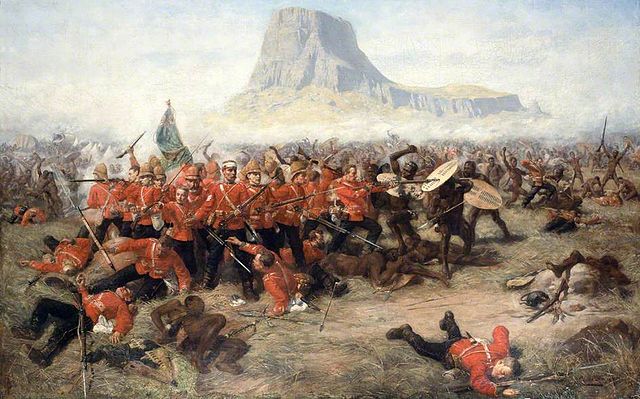
The annihilitation of a British column at Isandhlwana was brought about by Bartle Frere acting against the wishes of the government
India became by 1914 essential for the survival of the British economy. By then 60% of all Indian imports came from Britain and it received £380 million in British capital investment, 105 of all British investments overseas. As European rivals established their own empires and adopted tariffs to protect their own markets, it became more difficult for British traders to open up new markets. India became an absolutely crucial market for British manufactured goods, particularly cotton goods. With India being so important to Britain, there were no further annexations after the Rebellion of 1857. The policy of maintaining a firm control of India and exploit its potential as a market remained, but there was now a need to accommodate Indian middle class concerns. A policy of compromise along with coercion became the approach for British officials.
Formal empire brought to the Straits of Malaya
Elsewhere in the Far East, in the Malay straits, the British brought the peninsula under their control as local trading conditions were made difficult by the prevalence of piracy. With no part of the peninsula not too far from British military or naval forces and with no foreign power having an interest in the area, the conditions existed to enable the extension of more formal control.
The Malay Straits was characterized by piracy, robbery and plunder, slavery and a system of debt. Chinese secret societies offered their services to competing Malay factions. By 1870 the struggle for control of the best tin concessions had become especially bloody and besieged princes appealed for aid to the British.
In 1874 Abdullah, Rajah of Perak, one of several rajas who claimed the Sultanate of Perak, wrote to the Governor of Singapore asking for a British officer to teach him how to run his country. It was an opportunity the British could not resist. Within three weeks the British had gathered local Perak leaders and produced a treaty that gave the British influence and eventual control over the policies of local leaders. A constitution was negotiated which established a British Resident to advise Abdullah and a Treaty which amongst other things gave the British the right to determine all matters of finance, and outlawed slavery and kidnapping.
Local British officials then set about transforming the area. Malaya’s first railway line from Kuala Lumpur to the port of Klang, was built and as were new hospitals, police stations, jails and new housing - all paid for out of the revenue from the tin mines. Formal control enabled British run plantations to be established in an area that had previously suffered from piracy.

British officials in Perak with wealthy Chinese
Formal empire brought to Africa
Elsewhere, in Africa, the British government had to establish formal control over areas that previously had not had any formal British presence. The discovery of gold in the south in the Transvaal meant that there were possible competitors to British control of an area, deemed crucial to Britain’s maritime dominance. Although the British government did not want war with the Boers, the ‘man on the spot’, Lord Milner, made war inevitable by his refusal to come to any agreement with the Boer President, Kruger. Elsewhere in Africa, the British government had to grant subsidies to Kenyan settlers in order to maintain an important British colony in the face of a German presence in German East Africa. In west Africa, an area where thousands of British officials had suffered from numerous diseases, the adventurer Frederick Lugard was used to subdue and control areas of northern Nigeria threatened by the French advance from north Africa. Formal control was the last resort for a British government but in the face of increasing pressure from European and Asian competitors it was the only option left for Britain if control of areas deemed important to British mercantile interests be protected.
The official mind always favoured expanding trade through informal empire but in the last quarter of the 19th century, it became more and more difficult to sustain an increase in trade through informal trade alone. Governments of all persuasions in Britain remained committed free trade whilst industrial and commercial rivals used tariffs to protect their own developing industries and then began to acquire colonies to gain control over sources of raw materials and export markets.

Governor Percy Girouard being welcomed to Kenya 1909
In the 1880s British exports fell from an annual average of £234 million in the first half of the decade to £226 million along with rising imports . Britain’s share of world trade fell from 23% to 17% between 1880 and 1910 as rivals caught up and overtook Britain. At the outset of World War One, Britain’s share of world output was 15% compared with 35% for the USA and 16% for Germany. Britain was cushioned from the worst effects of a negative balance of trade by her invisible earnings of £3,780 million and attempts to use diplomacy to limit her loss of world trade had some success. Businessmen urged government to annex territories important to British trade and were helped by a popular press that used imperialistic adventures to sell newspapers to a jingoistic population. Increasingly the government turned to formalising relationships with territories that were important to British business. When informal empire collapsed in Egypt, an army was sent in 1882 under the command of General Wolseley to occupy the country by force. In 1884 a British army under General Warren was despatched to Bechuanaland to impose an element of British administration over the southern part of the territory.
The attitude of British governments to annexation remained the same throughout the century. Governments had to be flexible and respond to local conditions and the likely reaction in Parliament to their actions. With the growth of literacy after 1870 governments had to be alert to the views of the popular press but above all respond to the changing geo-economic and political situation.
By Peter Crowhurst, November 2021
Further reading:
Darwin, John, Imperialism and the Victorians: The Dynamics of Territorial Expanssion, EHR June 1997
Professor Richard Evans, Formal and Informal Empire in the Nineteenth Century, Gresham Lecture, October 2011
James, Lawrence, The Rise and Fall of the British Empire, 1998
Related Pages