


What was the role of the Royal Navy in suppressing the slave trade?
The abolition of the slave trade
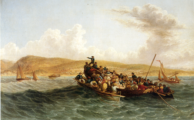
In 1808 following the passing by the British Parliament of the Slave Trade Act a year earlier, the Royal Navy established a squadron of ships based on the West African coast, the West Africa Squadron, whose job it was to suppress the trade in slaves to the USA and the West Indies. Between 1808 and 1860 the Royal Navy’s West Africa Squadron seized nearly 1600 ships involved in the slave trade and freed 150,000 Africans bound for the plantations of the Americas. The patrol began with just a few vessels and including privately owned ships but after 1815 the number of ships in the patrol increased dramatically and by the 1850s there were 25 ships with 2,000 officers stationed in West Africa. Britain used naval force and diplomacy to reduce the level of trading in slaves however a quarter of all the slaves who were transported across the Atlantic were transported between 1807 and 1870.
It was on March 25, 1807 that Britain formally abolished the Slave Trade banning British subjects from trading in slaves, crewing slave ships, fitting out slave ships and sponsoring slave ships. Abolition had come about through the evangelical revival with Quakers and Baptists convinced that African slaves were original sinners and were ripe for redemption as well as the efforts of those who highlighted the awful conditions in which Africans were transported and kept whilst working and living as slaves. The campaign for abolition of the slave trade began formally in 1787 when The Society for Effecting the Abolition of the Slave Trade was founded. Parliamentarians were eventually convinced of the moral cause for abolition, although the contradiction between Britain’s commitments to freedom and an empire largely founded and maintained on the use of force, was a dilemma that would undermine Britain’s claim to be the leader of the civilised world. Abolition of the Slave Trade did though enable Britain claim to have the moral ascendency over those countries that still permitted the slave trade to continue. Abolishing slavery though would take another twenty six years and only came about once it was realised that there would be no negative impact on the British economy.
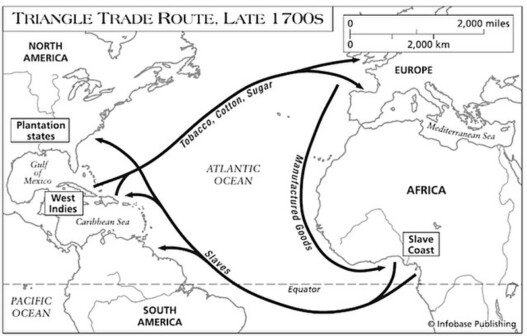
Slave trade routes
How to enforce the act?
To pass an act abolishing the slave trade was one thing, to enforce it another. In 1807 the war with Napoleon was still ongoing and few ships could be spared. Even when a substantial squadron was established with appropriate harbour facilities, the area to be covered was huge given the number of slaves still being trafficked. Few other countries showed any willingness to follow Britain’s lead and abolish the trade and with no international agreement in place, the focus of the government’s efforts to enforce the 1807 act and persuade other countries to forbid the trade or at least not hinder Britain’s efforts to do so , lay in securing international agreements.
Two ships sent to West Africa
In 1808 the Admiralty sent two ships to police the African coast with orders to stop any vessel carrying enemy colours as well as British ships. Sailing from Portsmouth where the ships were based, , the West Africa Squadron began with the 32 gun 5th rate frigate HMS Soleby and the brig-sloop HMS Derwent. In 1819 the Royal Navy established a West Coast of Africa Station and the squadron became known as the Preventative Squadron, an independent squadron until 1865.
The first Commodore of the Squadron, in 1818, was Sir George Collier with the 36 gun HMS Creole as his flagship. He was sent to the Gulf of Guinea with the orders ‘to use every means in your power to prevent a continuance of the traffic in slaves.’. At this time, the squadron consisted of just six ships to patrol over 5,000 kilometres of coast. In 1819 a naval station was created at Freetown, Sierra Leone where most of the slaves freed by the patrol chose to settle. With their slow vessels the squadron had little early success for the slavers often had faster Baltimore clippers however once captured slave clipper began to be used more slavers were captured. The captured HMS Black Jack caught eleven slavers in one year. In the 1840s the navy began to use paddle steamers which with their shallow draughts were able to patrol up rivers and along shallow shores.
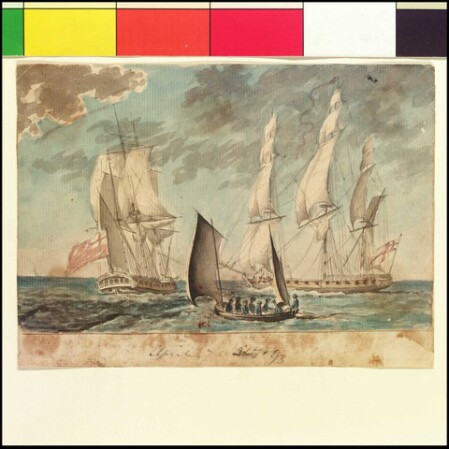
A slave ship being pursued by the Royal Navy
Portugal though was one of the main traders in slaves and was an ally however in 1810 under diplomatic pressure it was persuaded to sign a convention allowing British ships to police Portuguese ships but still allowing Portugal to trade those slaves that originated from its own African possessions. As well as the two naval ships sent, there were private ships operating under a letter of marque and able to chase slavers for profit. One of these private vessels was the Dart which made the first captures under the 1810 convention.
Actions taken to stop the slave trade
Another privateer Kitty joined Dart in 1813 although the two ships did not remain very long. In 1811 the number of naval ships was increased to eleven before the war between Britain and the USA meant that further additions had to be postponed. With peace in Europe established in 1815, Britain gaining absolute control of the seas of the world and at the Congress of Vienna Castlereagh was successful in getting all signatories of the final text to agree to commit themselves to work towards the abolition of the slave trade. In 1814 France agreed to end trading in slaves and in 1817 Spain agreed to abolish the trade in the northern hemisphere however little real effort was made by other countries to support Britain’s efforts. The Spanish, Portuguese and the Brazilians continued to traffic in human cargoes as their colonial economies were tied up with slave labour and the Americans had little enthusiasm to abolish the slave trade until after the Civil War had ended in 1865.
To help the Navy’s ships claim its prizes, a series of courts were set up along the African coast. In 1807 one was established in Freetown and in 1817 several mixed-commission courts with representatives from both Britain and from other powers.
Being a crew member on one of the Royal Navy’s ships on the West Africa Squadron must have been one of the worst postings a sailor could have. In the early years, the ships were too old and too slow to have much success in catching slavers and there had to be slaves aboard to provide the evidence required. In later years it was sufficient to see that the ship had ben built to take slaves whether slaves were aboard or not. Tropical diseases meant that the death rate was the highest any posting in the world for the Royal navy. Between 1830 and 1865 1587 men died from a variety of causes which included disease, killed in action and accidental deaths. The death rate was 55 per 1,000 men compared with 10 for fleets based in the Mediterranean. It was said of the Bight of Benin that ‘ one comes out for forty goes in.’ In 1829 over a quarter of the entire West Africa Squadron died from disease. This did though give Royal Navy surgeon plenty of experience with fighting tropical diseases.
Newspapers reported the exploits of the slave patrols
The pursuit of slaves was told in exciting detail by the British newspapers. On the night of 6 June 1829 the schooner Pickle had an engagement with the slaver Voladora which was told to the British public as were the exploits of HMS Monkey in the waters off the Bahamas the same month. In 1834 HMS Buzzard successfully chased and engaged the slaver Formidable and in 1838 the Electra captured a Carolina slaver with its human cargo. In 1841 the newspapers reported on the capture of the slaver Gabriel by HMS Acorn. All these exploits reported in the newspapers helped to enhance the reputation of the Royal navy and enabled Britain to portray itself as a nation based on a higher sense of morality.
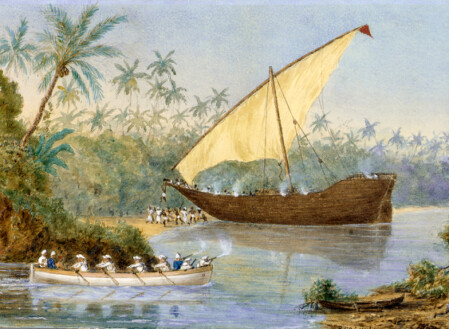
Kroomen slave hunters stop a slave dhow
By the 1850s, with around twenty five Royal Ships in
the West Africa Squadron, many of which were paddle steamers, and with other
nations giving Britain the rights to search their vessels, more and more slaves
were being freed. With the Webster-Ashburton treaty being signed with the USA
in 1842, the US began to contribute the use of their navy to the Africa
squadron, although it was only in 1861 that Lincoln gave the right for Britain to
search ships. Even with the support of the USA and the pressure exerted by Foreign
Secretaries like Palmerston and Russell, the Royal Navy only managed to free a
tenth of those who were destined for the Americas.
The sphere of operations extended
By the middle of the c19th the Royal Navy began to extend their sphere of operations to slave trading in North Africa, the Middle East, and the Indian Ocean. The main port of embarkation for slaves going to Arabia, Persia and India from India was Zanzibar and involved the trafficking of more than 20,000 enslaved people a year from what is now Mozambique to Kenya. In the 1860s David Livingstone produced reports of Arab atrocities against enslaved Africans and the Royal Navy did its best to suppress this trade in people although this caused friction between the Foreign Office and the Admiralty due to the interests of the government t in the Middle East. Bartle Frere was able to negotiate treaties with the sultans of Muscat and Zanzibar that helped Britain to lessen the trade out of Zanzibar as a result of a guardship, HMS London, being posted off the coast of Zanzibar. For four years London patrolled the waters of East Africa with some success and in an operation against Mombasa reduced the fort to rubble and thereafter made the sultan dependant on the British. Another successful Royal Ship was HMS Dryad which captured seven slavers during its tour of operations. During the various operations off the coast of East Africa 1,000 dhows were captured and 12,000 Africans were rescued from a life of slavery.
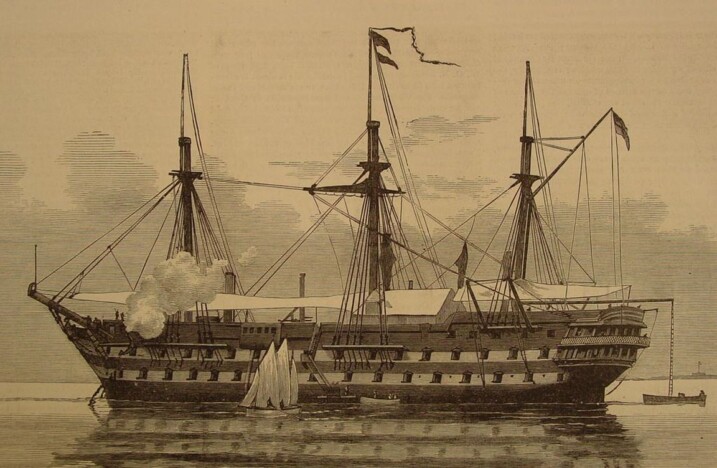
HMS London
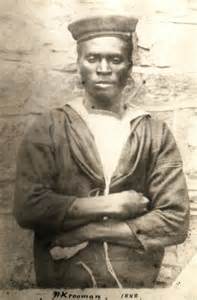
A Krooman sailor
Central to the success of the West Africa Squadron were those sailors called Kroomen, who were excellent swimmers and canoeists. The Kroomen originally came from what is now south east Liberia but by the c19th had established colonies in many coastal towns in West Africa. Kroomen were expert navigators and boatmen and were used in small canoes that could ride the surf. The Kroomen had a fierce opposition to the slave trade and once the West Africa Squadron was established and based in Freetown, they began to sign up for work on board Royal Navy ships.
A colony of Kroomen was established at Freetown and run along naval lines with Royal Navy discipline enforced. They could work in the naval dockyard if they couldn‘t get work aboard a fighting ship. Such was the dependence of the navy on them that stories of the bravery of the Kroomen appeared in Boy’s Own stories. Eventually in the 1870s, operations of the West Africa Squadron were reduced and the i9mperial government determined that the Kroomen would not be used in East Africa. By this time there was more discussion on the science of race and the Kroomen were likely victims of racism.
Stories of those who were rescued
There is not a lot of evidence on the experiences of the sailors of the West Africa Squadron or those who were freed but there are some stories. Samuel Adjai Crowther was one of the few enslaved Africans who was rescued, and we have documentation of what happened to him. He was rescued in 1822 when Crowther was 12 and re-settled in Freetown where he was baptised and educated. He was taken to England to complete his education in 1826 and returned again to England in 1843 to be ordained as a minister in the Church of England. He worked in various missions in West Africa promoting the Yoruba language and in 1864 became the first African bishop to be ordained in the Anglican Church.
Another African who was rescued was Tom Highflyer who
along with two other boys was rescued from a slaver dhow in October 1866 by
Captain Thomas Pasley of the Royal Navy’s East African Squadron. Captain Pasley
was commanding HMS Highflyer when Tom was rescued and named him after his ship.
At the time Tom was eight or nine years old and following two years at sea
following the rescue was brought to England. During his time on board HMS
Highflyer the three boys became firm favourites with the crew – the other boys
being named Sam Oldfield and Bob Dhow after their rescuers.. Little is known of
his movements in England except that he ended up in Brighton living in Great
College St. He did not live long in Brighton dying on June 20, 1870, when he was
about 12 or 13. He was given an elaborate and expensive gravestone so must have
had connections with a family of some means.
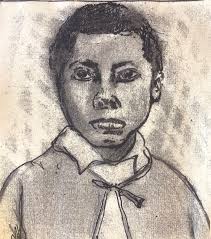
Tom Highflyer
The Royal Navy’s role in the suppression of the slave trade lasted into the 1870s after which its functions were taken over by the various naval stations in South Africa and India. The humanitarian motive behind the establishment of the West Africa Squadron was no doubt a genuine motive for many of the sailors although it helped address the guilt that many citizens no doubt felt about Britain’s involvement in the slave trade and slavery itself.
There were other benefits from Britain’s actions. Britain was able to claim that her empire was different to other empires in that it was based on a sense morality. The continued presence of Royal Naval ships off the coasts of Africa also increased Britain’s influence in the area, and the establishment of bases also enabled Britain to better do her work of defending Britain’s global network, and especially Britain’s informal trading connections. The use of steam ships to sail up shallow rivers was further used in Palmerston’s gunboat diplomacy, as seen in the Opium Wars.
One hundred and fifty years after the end of the West Africa Squadron’s work, the Royal Navy is still being used to deal with the trafficking of human beings, and slavery was still legal in Kuwait until 1949 and Qatar until 1952. Although the Royal Navy was used before 1807 to protect slave ships, it very quickly adapted to a role reversal when the West Africa Squadron was established. The number of rescued slaves may have been small, but Britain did lead the way in attempting to suppress the trade.
By Peter Crowhurst, August 2020
Further reading/research:
The Decline and Fall of the British Empire by Piers Brendon, 2007
The Rise and Fall of British Naval Mastery by Paul Kennedy, 2017
Kroomen: Black Slaver Hunters by John Broich in History Today, December 2017
Brighton & Hove Black History website https://www.black-history.org.uk/
The National Maritime Museum
If you would like to comment on this essay please contact me using the form below