

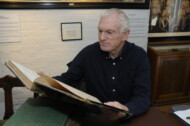
HMS Powerful and the Naval Brigade in Ladysmith
The Naval Brigades
Between 1850 and 1914, the Royal Navy only fought one ship-to-ship action, HMS Shah and HMS Amethyst against the Peruvian ship Huascar in 1877. The men of the Royal Navy did though see action in operations on shore. Seamen were trained for land based action at HMS Excellent in Portsmouth and then became part of temporary detachments, naval brigades, that ships could use. Such brigades were made up of seamen and Royal Marines and took part in operations in the Crimean War, the Second Opium War, the Indian Rebellion, the New Zealand wars, the Second Ashanti War, the 1882 Egyptian campaign, the Anglo-Sudanese War, the Second Boer War and the Boxer Rebellion in China. The most famous involvement of a ship’s naval brigade was in the siege of Ladysmith , at the beginning of the Second Boer War when the men from HMS Powerful used their ship’s guns to prevent the Boers from taking the town. This is the story of the involvement of HMS Powerful’s naval brigade in the siege.
The Arrival in South Africa of HMS Terrible and HMS Powerful
Within 48 hours of the outbreak of the Boer War, two large cruisers had arrived at the Cape. HMS Terrible and her sister ship HMS Powerful were due to exchange their stations with Terrible replacing Powerful on the China station. Because of the situation in South Africa, they had been re-routed via South Africa and they arrived at a critical time and were to play a pivotal role in the conflict. The Naval Brigades from both ships were to be involved in many actions of the Boer War and at Ladysmith, the navy's gunners determined the outcome of the siege.HMS Powerful
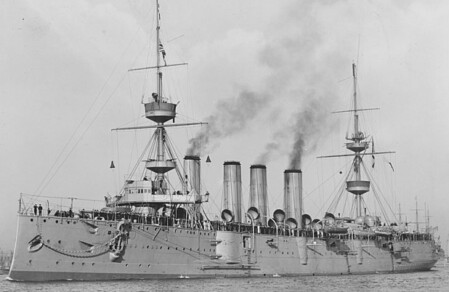
HMS Powerful was built by Vickers of Barrow and when launched in June 1897 was, along with her sister ship Terrible, one of the largest cruisers afloat. Her main armament consisted of two 9.2" guns and twelve 6" guns. Her complement was 894 men commanded by Captain The Honourable Hedworth Lambton. Following her fitting-out she was sent to the China station and was being brought back to the UK in September 1899 when she was diverted to the Cape .
Powerful and Terrible were to meet on 14 October in the British naval base at Simonstown, close to Cape Town. They then began to prepare their guns for use on land. Luckily, the captain of the Terrible was Percy Scott, the navy's leading gunnery expert, and he supervised the building of carriages that would carry the 12 pounder guns on land. These guns and their carriages were ready on 20 October but already by that time a Naval Brigade made up of men from both ships and other ships based at Simonstown and equipped with conventional artillery had been landed to guard an important railway junction at Stormberg. This contingent was commanded by Commander Ethelston of Powerful. Commander Ethelston would die on 25th November in the Battle of Graspan, one of the earliest engagements to relieve Kimberley.
On 25 October, the Naval Commander at Simonstown received a telegram from General White asking for Naval personnel and for long range guns to reinforce his own artillery at Ladysmith. Scott quickly improvised land mounts for two long range 4.7" guns to go with the already mounted 12 pounders.
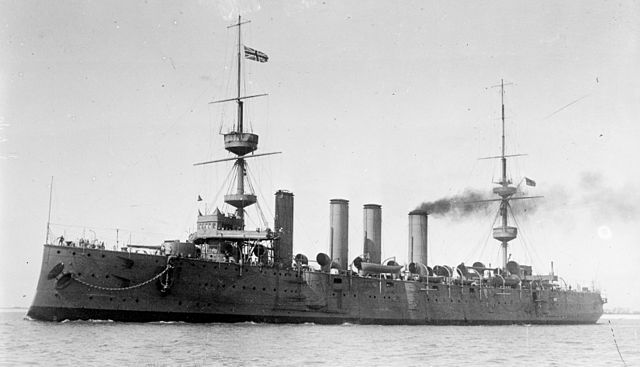
HMS Terrible
Ladysmith
General White, commanding the Natal Field Force, had split his force into two, sending a brigade of 4,000 men to Dundee whilst keeping the main force of 8,000 at Ladysmith. The brigade at Dundee under the command of General Penn Symons fought the first engagement of the war just north of Dundee on Talana Hill on 20th October. Symons managed to drive the Boers off the hill but at a huge cost - his own life and 500 of his men to the 150 lost by the Boers. The new commander, General Yule, then decided to retreat to Ladysmith. Despite this pyrrhic victory, and another one at Elandslaagte on 21st October, there were several columns of Transvaalers and Free Staters converging on Ladysmith from different directions. On 24th October, a British force of 5,000 managed to hold off the Free State commandos that had occupied and looted Dundee and then themselves retreated into Ladysmith. It was at this point that General White telegraphed for artillery assistance to the commander of the naval base at Simonstown. By the following day, the 28 October, the Boers had cut off Ladysmith's water supply. Cavalry and balloon reconnaissance revealed that Free State commandos were moving towards Colenso cutting off communications to the south whilst other forces were advancing from the north west, from the north and from the east. White believed he was heavily outnumbered and outgunned but rather than retreat he decided to remain in Ladysmith. He believed that to give up Ladysmith might well have encouraged the Afrikaners in Natal and the Cape Colony to rise up. Moreover, to give up Ladysmith would have enabled the Boers to utilise the railway and bring supplies and men right down to the Tugela River. Although White was later to be heavily criticised for not retreating, Lord Roberts, later Commander-in-Chief in South Africa, defended his decision.White waited for his men to recover from the battles they had been involved in before attempting a counter-attack on Monday 30 October. This was a huge gamble. Rather than retreat to south of the Tugela River, White believed he could deliver one knockout blow on Joubert's army and so on 30 October, forces were sent out to capture Nicholson's Nek, Long Hill and Pepworth Hill. With mules stampeding with their artillery pieces, and men finding themselves out of position as well as the Boers not being where they were supposed to be, the day was a calamitous one. Carleton's force of 1,000 men at Nicholson's Nek was completely lost with 800 men being captured by the Boers and the other targets were not gained. Had it not been for the timely arrival of the Naval Brigade, the day, to become known as Mournful Monday, might have been a whole lot worse. With the arrival of HMS Powerful's Naval Brigade, General White now had the means to defend Ladysmith against the Boers 'Long Toms' which outranged all the artillery that General White had at his disposal.
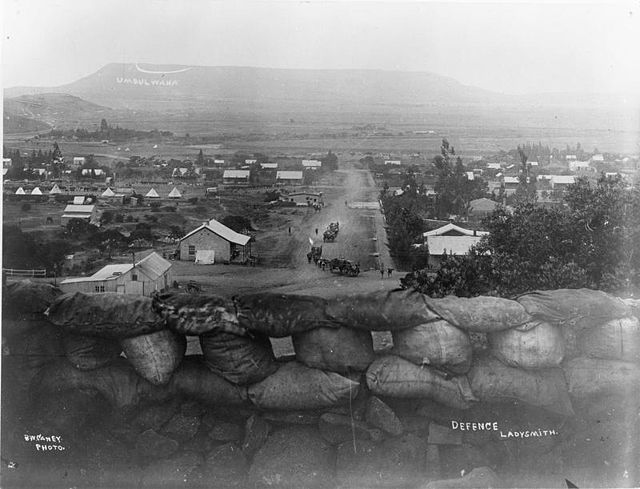
A Boer photograph of Ladysmith
Powerful's Naval Brigade Arrives in Ladysmith
The Powerful's Naval Brigade consisting of 283 officers and men, had arrived at the port of Durban on 29th October and travelled overnight by two trains to Ladysmith. The Brigade had with them two 4.7" guns, four 12 pounders and four Maxim guns. The first detachment from the brigade arrived at 6am in Ladysmith in the middle of the Battle for Ladysmith. It had taken them just six days to adapt the 4.7" guns and then transport them by ship and rail to Ladysmith. Unfortunately, in the quest for speed, the Brigade did not bring sufficient ammunition. Percy Scott had asked for 5,000 rounds for the 4.7" guns but was given only 500 rounds - enough for 25 minutes of rapid firing. Departmental arguing saw to it that after Lambton had procured a further two 12 pounder guns, he was not to receive any further ammunition.
As soon as the Brigade arrived at Ladysmith Station it was under fire from the enemy. The 12 pounder guns were then transported using oxen and manpower to their positions and it was not long before they were finding their range and silencing the enemy's 'Long Tom', referred to as 'Puffing Billy' by the British. One enemy shell did dismount one of the 12 pounders and wounded three of the gun crew, the first casualties of the ship in South Africa.
It took several days for the 4.7" guns to be pulled to their positions on Junction Hill and Cove Redoubt from where they could fire on the Boers' long range guns (named Long Toms by the British). On the first day that the 4.7" guns were in action, 2 November, Lieutenant Egerton was killed by shells from Long Tom. His legs were hit by a shell bringing the response: "My cricketing days are over". His legs were amputated and by the afternoon he was cheerfully sitting up drinking champagne, but he died in the evening. On this day, the Naval Brigade's long guns were being fired on by at least five Boer guns and the town found itself finally cut off.
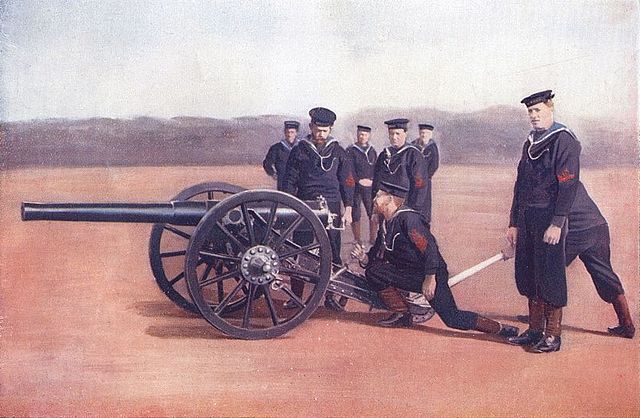
A 12 pounder and its naval crew
The Siege of Ladysmith
With the arrival of the Naval Brigade and a battalion of the Rifle Brigade on the 30th October, the total force at Ladysmith reached 12,500 offices and men. There were about 5,400 civilians and 2,400 Africans and Indians making a total of 21,300. There was enough food for two months at normal consumption rates. There were nearly 10,000 horses and mules and 2,500 oxen that also had to be fed.
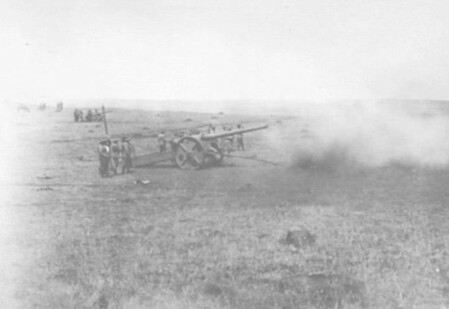
A 4.7 in naval gun in action at Colenso
The besieging of almost the entire Natal Field Force left the Colony virtually defenceless until the arrival from England of Buller's army corps, the advance guard of which landed at Cape Town on 4 November.
The Boers encircled the town within a six mile radius, mostly from hill positions, whilst the British manned a smaller defensive ring. The Boer tactics were to try and starve and bombard Ladysmith into surrender whilst keeping Buller and his force of 18,000 men at bay south of the Tugela. River Both sides believed that the siege would be a short one - the Boers thinking that they could force White to surrender whilst White himself expected that Buller's army would not be long in relieving the town. The Boers only made one attempt to break through the defensive ring around Ladysmith - on Bester's Ridge on 6 January. For the rest of the time the Boers were happy to tie up this large force of British soldiers with the occasional shelling.
Conditions in Ladysmith
Conditions within Ladysmith at first were not too bad. There was edible food and sports events were held to keep up morale, and although there was daily shelling, there were relatively few casualties. Caves were dug into the river bank for women and children who wanted to stay in the town and those who didn't could go to Intombi just a few miles south of the town. The main problem for those in Ladysmith was the lack of clean water and the poor sanitary conditions. It was the height of summer with temperatures often over 90 degrees, unbearably hot and with plagues of flies covering everything. By January 1900, only 9,500 of the original 13,500 men were fit for duty - many were suffering from enteric fever. The coal needed to operate the water condensers had been exhausted and enteric would gain a hold over the town. In February 1900 horses were slaughtered in large numbers for food, and 'Chervil' horse extract was produced for human consumption. Most of the cavalry horses had already been turned loose to graze as there was no more fodder available for them. The men were too weak to make any offensive movement against the Boers even with the imminent arrival of Buller at the end of February. By the end of January, the average number of enteric cases was eight a day and fever cases at Intombi had reached their peak at 1,314 cases.
The role of the naval brigade at Ladysmith
The role of the Naval Brigade was to keep at bay the Boers' long range guns and minimise the damage they were doing, either by destroying the enemy emplacements or reducing their effectiveness. The Boers brought into action at Ladysmith four 155mm Creusot guns, four 120mm Krupp howitzers and six 75mm Creusot field guns as well as a dozen other guns. The range of these large guns was 10,000, 6,000 and 5,000 yards respectively and they were positioned on the larger hills around the town - Pepworth Hill, Lombard's Kop, Surprise Hill, Telegraph Hill, and Mt Bulwana. The Naval Brigade had a 4.7" gun mounted on Cove Redoubt, a second 4.7" in gun on Junction Hill (later moved to Wagon Hill and Caesar's Camp) and 12 pounders on Gordon Hill, Caesar's Camp and Cove Redoubt. There was also a .45 maxim on Gordon Hill throughout the siege.
The 4.7" on Junction Hill (nicknamed Lady Anne) was eventually able to knock out the 6" gun on Pepworth Hill, whilst the 4.7" on Cove Redoubt (Bloody Mary) was to repeatedly hit the emplacement on Mt Bulwana at a range of between 8,200 and 8,900 yards. To help find their targets the Naval Brigade built a conning tower close to the 4.7" guns and whenever the enemy was seen to have fired its guns, its fire was returned with a shell that reached it three seconds before its shell reached its own target. This gunnery duel was helped by the way by which the Boers conducted themselves. The Boers never fired before breakfast and never at night. They knocked off regularly for meals with their riflemen lunching between 11.30 and 12 whilst the gunners lunched between 12 and 12.30. They hardly ever fired at tea-time and never when it rained. Sunday was a holy day for the Boers who attended church services so giving the British a day off from being shelled. Outside of Ladysmith, Generals White and Joubert had agreed that there could be a hospital for the sick and also for the children and women at Intombi just south of Ladysmith, and there was a daily train to carry people to and from there. Whenever the Boers wanted to repair their guns they hoisted a white flag which generally brought a truce from both sides.
Charles Reynolds Sharpe’s memoirs
One of the Naval Brigade was Charles Reynolds Sharpe, who at sixteen was the youngest member of the Powerful's crew. Sharp kept a diary throughout the siege and here are some extracts from it which illustrate what it was like inside Ladysmith:
3 November. Manned the trenches as usual at 3.45 am. At 8am the Boers opened fire with 6" and 12 pounders, we returned with a few rounds from the 4.7 and 2 pounders. During the afternoon we have a very good shot with the 4.7, they then waved a white flag: we ceased firing; about half an hour later they fired again but it fell very wide.
9 November. At 12 noon fired a salute of 21 guns with shells in honour of the Prince of Wales' birthday. The Boers returned with 9 guns, also with shells.
16 November. When we manned the trenches in the morning Masters, AB, vaulted over the parapet and sat on his own bayonet. Luckily, he did not hurt himself seriously although the bayonet went right in right up to the hilt.
15 December. The shells fired by the relieving column (Buller's force at Colenso) were plainly seen. Bulwana fired several rounds, and Telegraph Hill and the howitzers exchanged a good many shots.
1 January. Bulwana and Telegraph Hill started firing early, the howitzers replying to the latter. Lieuenant. Stabb was taken down to the field hospital today with enteric fever. Heard a little firing down south.
17 January. Heavy firing to the southward; everyone hoping to be relieved within a week. Bulwana, Surprise Hill and a host of smaller guns firing all day.
22 January. Heavy firing heard more to the northward. Payne AB and Stroker Wheeler were killed white attempting to open a 6 in shell in the town strictly against the Captain's orders.
27 January. A little firing today. Still too thick for heliographing till the evening when we got a message: 'Warren's troops took Spion Kop, held it all day but lost it that night.' This looks as though relief was further off than ever.
2 Feb. Horse soup 'Chervil' is to be served out to the troops from today.
22 February. Very good news. Buller has taken several important positions and is getting on well. Lord Roberts has Cronje surrounded about 30 miles from Jacobsdaal. Bulwana fired on our 12 pounder on Caesar's Camp and gave them a very hot time blowing away one side of the gun pit. The 12-pr fired several shots at a party of Boers working on a dam in the river just below Intombi.
28 February. Two squadrons came in under Lord Dundonald of the South African Light Horse. It appeared afterwards that the Boers bolted without taking anything with them leaving rifles, tents etc behind them.
Midshipman Sharp confines most of his comments to the artillery duel with the Boers but his colleagues were suffering badly from enteric fever as were all those imprisoned in Ladysmith. By the time the town was relieved on February 28th, 33 men from Powerful's Naval Brigade had died out of the 283 men who had arrived on October 30th. Of those 33, just six men had been killed as a result of enemy action. The remainder had died of disease.
The siege lasted 118 days and the role of the Naval Brigade was absolutely crucial. The long guns were more than a match for the Long Toms of the Boers and kept them at bay. Without the naval guns the Boers would have been able to launch attacks which might have succeeded. If Ladysmith had succumbed then the Boers would have been able to use the railway all the way to Colenso and might have been in a position to have made an attack into the interior of Natal.
George W. Steevens, a Daily Mail correspondent present in Ladysmith, who died before the town was relieved wrote an account of the siege including this piece about the value of the Naval Brigade- "This handful of sailors have been the saving of Ladysmith. You don't know, till you have tried it, what a worm you feel when the enemy is plugging shells into you, and you can't possibly plug back. Even though they spared their shells, it made all the world of difference to know that the sailors could reach the big guns if they ever became unbearable. It makes all the difference to the Boers too, I suspect; for as sure as Lady Ann or Bloody Mary gets on to them, they shut up in a round or two. To have the very men among you makes the difference between rain-water and brine.
The other day they sent a 12-pounder up to Caesar's Camp under the command of a boy who, if he were not commanding big men round a big gun in a big war, might with luck be in the Fifth Form. 'There's a 94-pounder up there,' said a high officer, who might just have been his grandfather. 'All right, sir,' said the child, serenely, 'we'll knock him out.'
He hasn't knocked him out yet, but he is going to next shot, which in a siege is the next.
The return of HMS Powerful to Portsmouth
Following her exploits in South Africa HMS Powerful returned to her home port of Portsmouth arriving on 11th April. The news of the participation of the Naval Brigade in the siege at Ladysmith was well known and the men were regarded as heroes. All the ships at dock in the harbour were decorated with flags to welcome Powerful home. There was to have been a celebratory dinner that evening but it was postponed until April 24th at which time the Mayor of Portsmouth presented a silver watch to every member of the crew. The watches were engraved with the words ‘Seige of Ladysmith 118 days 1899-1900’ followed by the name of the recipient and HMS Powerful. Later the men were presented by Lloyds, a round silver tobacco tin with a crest portraying the flag of St George and a ship’s anchor engraved on the lid.
The story of Powerful’s participation in the Boer War and the carriage of her guns from Durban Harbour to Ladysmith led to the Naval Field Gun Run at the Royal Tournament from 1907.
By Peter Crowhurst, May 2021
Further Reading:
The Boer War, Thomas Packenham, 1979
Related Pages: