


Sake Dene Mahomet
The first Indian writer
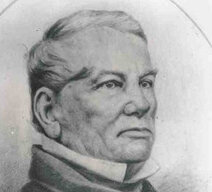
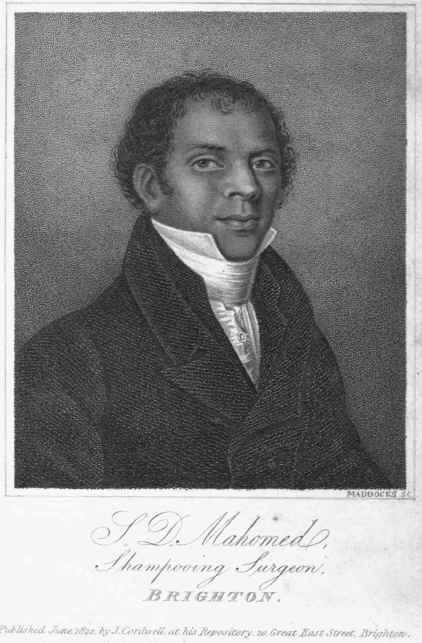
Sake Dene Mahomet (also spelt Mahomed) went on to become the first Indian writer to publish a book in England and also establish the first Indian restaurant in Britain. He is perhaps more famous though for being appointed ‘shampooing surgeon’ to George IV. He illustrated how the British Empire influenced the cultural life of the country and in particular the impact of orientalism. He was to acquire fame if not fortune in Brighton, a town dominated by the Royal Pavilion and the adjacent Dome, buildings which reflect the attraction of the orient for the British at the beginning of the c19th. Mahomet was not a good business and had to resort to a number of dubious means to promote himself. He would have adapted to a business world dominated by customer revies and ‘likes’ for he used and made up references from clients in order to promote his business, especially when confronted by competition.
An Indian sepoy
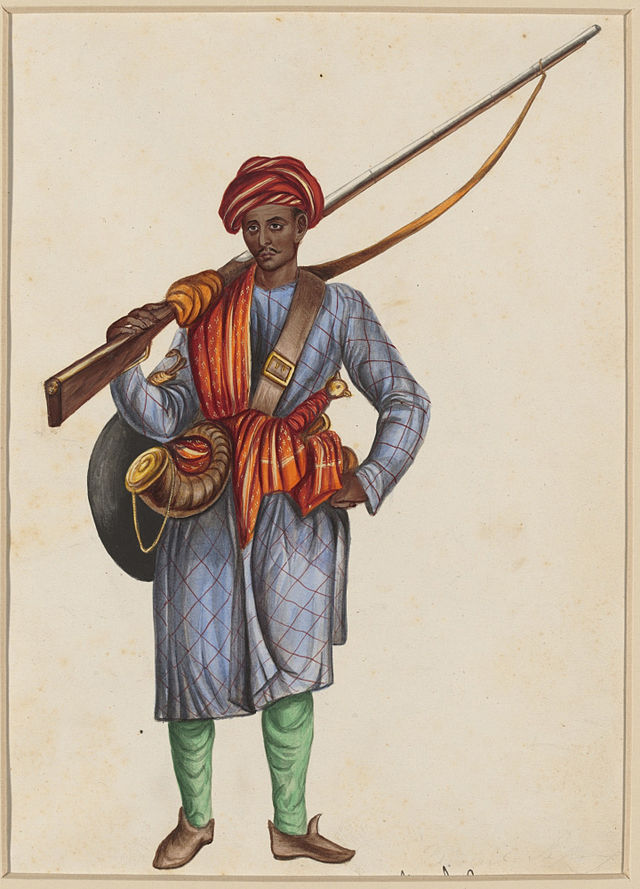
A sepoy in the Indian army
Mahomet was born, Sheikh Din Muhammad in Patna, India in 1759 to a Muslim family. His father was a sepoy in the Indian army and the family would accompany him on his many fighting campaigns. When he was ten his father was killed in action, and soon after, Mahomet joined his father’s old regiment. Mahomet soon began to attach himself to a teenage Anglo-Irish officer, Godfrey Baker and over the next fourteen years, the pair became quite attached. Baker rose to become a captain whilst Mahomet became a trainee surgeon and rose to the rank of a subaltern officer - -one of the highest ranks an Indian could aspire to.
Mahomet's writings
Mahomet was to write of his travels with Baker in his book ‘Travels’ published in 1794. In this book Mahomet wrote of the different types of landscape they visited which raged from dense jungle to arid plains and rich agricultural regions. Mahomet also wrote of the cultural life of the Bengali people describing their social organisation and domestic customs and food.
In this extract Mahomet describes how he came to meet Godfrey Baker. The English is surprisingly correct however he had been taking lessons prior tot the writing of the book.
Nothing could exceed my ambition of leading a soldier's life: the notion of carrying arms, and living in a camp, could not be easily removed: my fond mother's entreaties were of no avail: I grew anxious for the moment that would bring the military Officers by our door. Whenever I perceived their route, I instantly followed them; sometimes to the Raja's palace, where I had free access; and sometimes to a fine tennis court, generally frequented by them in the evenings, which was built by Col. Champion, at the back of his house, in a large open square, called Mersevillekeebaug [Mir Afzal ka Bagh]: here, among other Gentlemen, I one day, discovered Mr. Baker, and often passed by him, in order to attract his attention: he, at last, took particular notice of me, observing that I surveyed him with a kind of secret satisfaction; and in a very friendly manner, asked me how I would like living with the Europeans: this unexpected encouragement, as it flattered my hopes beyond expression, occasioned a very sudden reply: I therefore told him with eager joy, how happy he could make me, by taking me with him. He seemed very much pleased with me, and assuring me of his future kindness, hoped I would merit it. Major Herd [Heard] was in company with him at the same time: and both these Gentlemen appeared with distinguished eclat in the first assemblies in India. I was decently clad in the dress worn by children of my age: and though my mother was materially affected in her circumstances, by the precipitate death of my father, she had still the means left of living in a comfortable manner, and providing both for her own wants and mine.
Ireland
In 1783 Baker
retired from the Indian army and returned to Ireland accompanied by Mahomet who
had himself decided to leave the army. In Ireland Mahomet created a new life
for himself. He took English lessons to improve his understanding of English
life and he was soon able to meet and socialise with the Anglo-Protestant
elite. He stood apart from them in colour and culture but with his
understanding of what poetry and books were being read he was accepted into
local society.
In 1786
just a short while after Baker died, Mahomet got married to a local girl, Jane
Daly. They set up home in Cork and it seems lived a fairly comfortable life
suggesting that he might have brought money with him from India or that Baker
may have established Mahomet in Cork.
It was
during his time in Ireland that Mahomet wrote his book ‘Travels’ as a series of
letters to friends. It seems that around 1807 the family‘s relations with the
Baker family may have become strained and so at the age of 48 Mahomet moved to
London. The years spent in Ireland, and particularly a possible quarrel with
the Baker family, may have caused Mahomet
some distress for he never referred to his time there in his future
writings. He attempted to write his time in Ireland out of his life and with
many of the history books dealing with his time in Brighton giving his arrival in Brighton as 1784, he must have
let it be known in the town that he had arrived in 1784 when he was in fact in
Ireland.
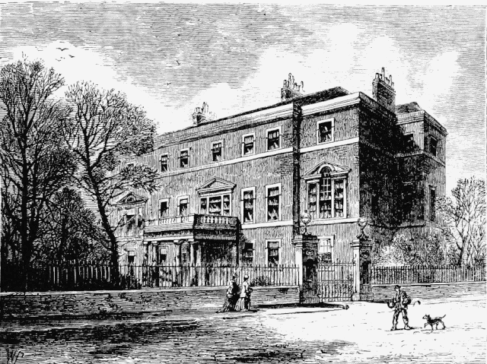
Portman Square
London
In London, the family settled in the Portman Square area and Mahomet was soon working for a rich Scottish nobleman, Sir Basil Cochrane, who had himself lived in India where he made his fortune before returning in 1805. Much of Cochrane’s money had been made from the Royal Navy contracts that he was responsible for negotiating.
Whilst he was in India Cochrane came across the idea of a vapour bath and decided to introduce the practice to London. In fact, the idea of vapour baths was not new and Turkish baths had been in use in London since 1631. Mahomet worked for Cochrane at the baths which were established and built at Cochrane’s plush residence in Portman Square, and added the practice of ‘shampooing’ or having a therapeutic massage. Soon the practice of shampooing became quite the fashion in London and many rival bathhouses were opened up, but Mahomet got no credit for what he had introduced to the aristocratic elite in London.
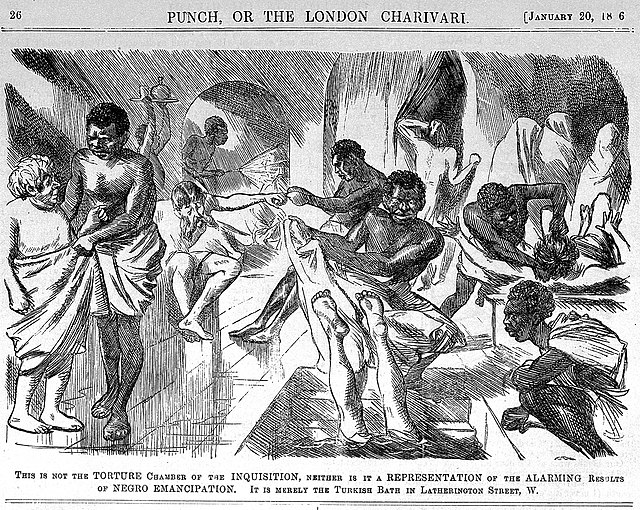
Victorian Turkish Baths
The Hindoostanee Coffee House
In late
1809 Mahomet opened an eating house in London and called it ‘Hindostanee Coffee
House’ to use his Indian identity to market this new business venture. His
customers were largely Europeans who had worked in India. He located the
business near Portman Square, on the corner of George and Charles St, and the
site is now marked by a plaque. It was not really a coffee house at all but an
Indian restaurant serving a rage of meats and vegetables cooked with herbs and
spices. The walls were decorated with pictures of the orient and he advertised
in the local newspapers.
Hindostanee Coffee-House, No. 34
George-street, Portman square—Mahomed, East-Indian, informs
the Nobility and Gentry, he has fitted up the above house, neatly and
elegantly, for the entertainment of Indian gentlemen, where they may enjoy the
Hoakha, with real Chilm tobacco, and Indian dishes, in the highest perfection,
and allowed by the greatest epicures to be unequalled to any curries ever made
in England with choice wines, and every accommodation, and now looks up to
them
for their future patronage and support, and gratefully acknowledges himself
indebted for their former favours, and trusts it will merit the highest
satisfaction when made known to the public
Although Mahomet’s new restaurant was an attraction it
did not manage to create a regular clientele, and with high start-up costs he
needed to acquire additional funds quickly. He took on a partner, John Spencer,
but this proved to be a mistake and in March 1812 Mahomet petitioned for bankruptcy. The family spent the next
year dealing with the legal problems of the bankruptcy until in July 1813 his
assets were divided up amongst his creditors. By this time, the family were
living in a boarding house on Paddington St. Mahomet tried to get a position as
a ‘Valet to a Gentleman’ but with little success. Instead he found work in a
bathhouse.
Brighton
Mahomet decided to try his luck in the fastest growing town of the country -the
resort of Brighton then frequented by the Prince Regent and the English aristocracy. Mahomet found
premises at 11 Devonshire Place and it was here that Mahomet established his
first vapour business, calling themselves bathhouse keepers. Brighton had
established itself in the previous half-century as England’s most fashionable
seaside spa. The writings of several
doctors had praised the climate of Brighton and its seawater cure. As
well as facilities for outdoor bathing there were many indoor activities to
attract the growing number of aristocratic families. With Brighton being in the
front line in the Napoleonic War, and the Prince Regent having built a marine
pavilion for his annual stays in the resort, there were plenty of potential clients for these ‘cures’
offered for every possible ailment.
Mahomet and Jane began to treat invalids with their
own form of vapour bath which had added herbs and was named ‘the Indian
Medicated Vapour Bath’. This was just a refinement of what Mahomet had used
in Cochrane’s vapour room. Mahomet had to emphasise the Indian nature of what
he had to offer, and he claimed that all the herbs and oils were brought from
India. A range of exotic goods were also sold such as ‘Indian Tooth Powder’ and
‘Culeef ‘which was a dye for changing the colour of hair to a glossy black.
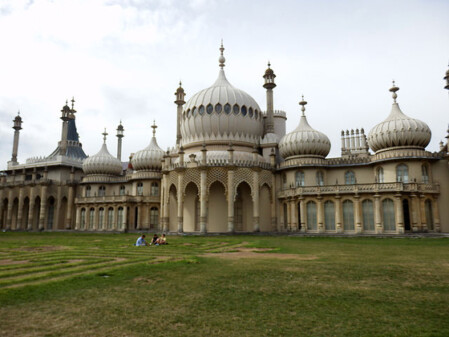
The Marine Pavilion was being transformed into Nash's Royal Pavilion when Mahomet arrived in Brighton
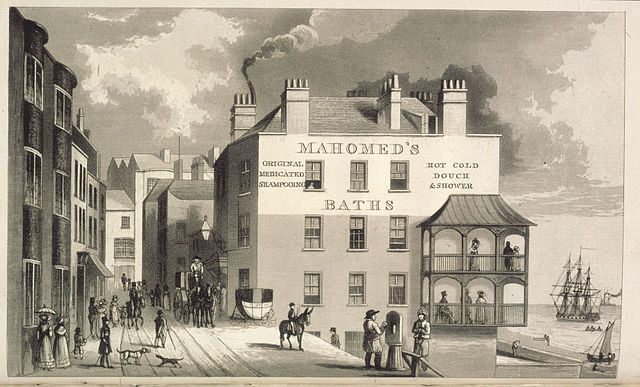
To advertise his methods Mahomet took out
advertisement with the local newspapers.
Mahomed's Steam and Vapour Sea Water Medicated baths…are far superior to the common Baths, as they promote
copious perspiration, and never fail in giving relief when every thing else has
been tried in vain, to cure many Diseases, particularly Rheumatic and Paralytic
Affections of the extremities, stiff joints, old sprains, lameness, eruptions,
and scurf on the skin, which it renders quite smooth; also diseases arising
from the abuse of mercury, consumption, white swellings, aches and pains in the
joints; in short, in all cases where the circulation is languid, or the nervous
energy debilitated, as is well known to many professional gentlemen and others
in this country.—Mr. M. has attended several of the Nobility with the happiest
results, can give most satisfactory references.
N.B. Board and Lodgings in his House, if required.
Mr. and Mrs. Mahomed Possess the Art
of shampooing
A successful business
The business became successful quite quickly and
within a year Mahomet began to claim he had successfully treated hundreds of
cases. In 1815 a daughter Rosanna was born and not long after, the business
moved from Devonshire Place to the former Battery House and it was here that
over the next few years his family grew with the addition of Horatio (1816),
Frederick (1818), Arthur (1819). It was also here that the family buried little
Rosanna who died in 1818.
From 1818 Mahomet began to call himself a Shampooing
Surgeon and then two years later felt he had been successful enough to
publish a book that contained many of his successful cases including
testimonials from those patients. He called the book, ‘Cases Cured by Sake
Deen Mahomed, Shampooing Surgeon, and Inventor of the Indian Medicated Vapour
and Sea-Water Baths. Not only was he now calling himself a Shampooing
Surgeon, but he had taken on the honorific title ‘Sake’ and changed the
spelling of his name to Mohamed.
As the business expanded his accommodation
proved to be too small so he had new baths built on the newly opened Kings Road
on the west cliff. These premises, built with the financial help of a London
backer, Thomas Brown, overlooked the sea and stood quite prominently on the new
seafront road. The building became one of Brighton’s most prominent buildings
and attracted customers for the next twenty years.
The décor of this new building recalled vistas
of India and the walls were covered with the implements that successful cures
had made redundant: spine-stretchers, crutches, club-foot reformers. There were
separate bath-rooms for ladies and gentlemen who each had their parlours for
rest. All of the bathing rooms were fitted with a marble bath, and
have the means of giving in the same room hot water, cold water, shower, and
douche baths. Four of them are also fitted with the Indian vapour or shampooing
baths, two of which are appropriated for ladies and two for gentlemen. “Mahomet
employed two men and three women whilst his family lived close by in a very
comfortable house. As his business flourished Mahomet felt the need to provide
for himself a medical background and he began to claim that he had had formal
medical training in India. These claims appeared in the subsequent editions of
his book ‘Shampooing’.
Shampooing Surgeon to George IV
Mahomet became one of Brighton’s most famous residents and
received warrants of Appointment as a royal Shampooing Surgeon from both George
III and William IV as well as administering to the poor. His visits to the
Royal Pavilion became the subject of
much gossip in the town but as William changed his allegiance to other
bathhouses, Mahomet fell out of favour, and the building works on the seafront
disrupted his business. He began to offer a mobile bath service but at over
eighty Mahomet was finding the business exhausting. His silent partner, Thomas
Brown died in 1841 and his executors decided to sell Mahomed’s Baths. Mahomed
did not have enough to buy the business he had established twenty years
previously. Mahomet and Jane were forced to leave their home on the seafront
and move to less extravagant accommodation in Black Lion Street where they
attempted to carry on their business from their new modest home., until in 1845 their youngest son, Arthur
Ackber, took over the running of the
business. By now Mahomet was largely forgotten by the town and Jane and Mahomet
died within two months of each other, in 1850 and 1851. The couple were buried
together in St Nicholas churchyard.
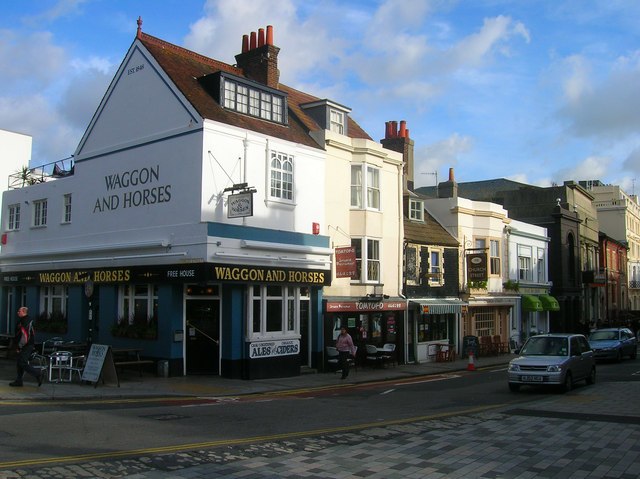
Frederick and The Waggon and Horses
Although people had forgotten Mahomet and Jane, a number of their children were to achieve success in their own chosen professions. Frederick decided not to join the family business but to set himself up as a dancing, fencing and gymnastics teacher. He built a gym at the corner of Church St and Jubilee St which opened in 1848. The building is still there as the Waggon and Horses public house, which opened as a public house in 1848 when Frederick moved his busines to other premises.
Frederick Horatio
Frederick’s eldest son, Frederick Henry Horatio Akbar,
achieved success in the field of medicine. He trained at Sussex County Hospital
and then Guy’s Hospital, London,.
Qualifying in 1872 as a Member of the Royal College of Surgeons. Whilst
a student Frederick modified the sphymograph, a device to measure blood
pressure and he was the first person in Britain to recognize that high blood
pressure was a primary condition of kidney damage.
Frederick married Ellen Clark a year later in 1873
at
St Nicholas Church . Frederick worked in Highgate, Islington, and Paddington
before being appointed as medical registrar at Guy’s in 1877. Ellen had died
just a month after giving birth to a daughter, Ellen, in 1876 and Frederick
moved in with his uncle Horatio who lived near Portman Square. Frederick
married Ada, the youngest sister of Ellen, in 1879.
In 1884, whilst Frederick and his family were living
at 24 Manchester Square, he contracted typhoid, possibly from a patient where
he was working at the London Fever Hospital. He subsequently died on 22
November from a haemorrhage and was buried in Highgate Cemetery.
Related Pages
