


The Development of Brighton

The Development of Brighton 1750 – 1870
The article Reparative Histories by Cathy Bergin and Anita Rupprecht asserts that many of those who are on the LBS database and lived at some time in Brighton and Hove invested in the new developments along Brighton’s east cliff, using money earnt from the slave trade. It is my contention that most of the houses referred to were built a long time before those on the LBS database arrived in Brighton and Hove. As councillors have stated that Georgian Brighton was developed with money earnt from the slave trade, it is important that I look at how and when Georgian Brighton was in fact developed.
The development of Brighton as a seaside resort dates from around 1750 when doctors like Dr Russell began to move to Brighton and advertise the benefits of bathing and various cures associated with seawater. Between 1750 and 1780, all those facilities sought by the aristocracy in a resort (including ballrooms, libraries, coffee houses, lodging accommodation, places of worship, good transport links) were available.
By 1780, Brighton had been transformed into a fashionable resort, made possible by having a sheltered place for visitors to promenade on in the Steine, good transport connections to London, as well as plenty of cheap land. By the mid-1750s, plenty of the aristocratic elite were visiting Brighton and, as the numbers increased each year, so more facilities had been made available. The arrival of the Prince of Wales in 1783, and his subsequent yearly visits, may have helped promote the town but it was more likely the arrival of thousands of troops based in Brighton and Hove during the Napoleonic Wars that made Brighton one of the fastest growing towns in the country at the beginning of the 19th century.

Comments welcome. Please use the Contact Form
Two of the early developers in the 1750s were Dr Russell, who built a large, detached house for his consulting rooms on the west side of the Steine in 1752/53, and Samuel Shergold, an innkeeper from Lewes, who developed and later expanded the Castle Inn, where the Assembly Rooms were the social centre of Brighton. When Shergold decided to redecorate the Assembly Rooms at the Old Ship in the 1770s, he borrowed money by raising mortgages on the inn and entering into a partnership. The mortgagees were local businessmen from Lewes and local gentry. He most likely raised the money for the first Assembly Room in 1754 in the same way. Another developer of the resort was John Hicks of the Old Ship who extended the Old Ship to include Assembly Rooms. To pay for the work, Hicks mortgaged his inn to local gentry. Hicks and Shergold co-operated to provide Brighton with alternate assemblies at the Old Ship Inn and the Castle Inn.
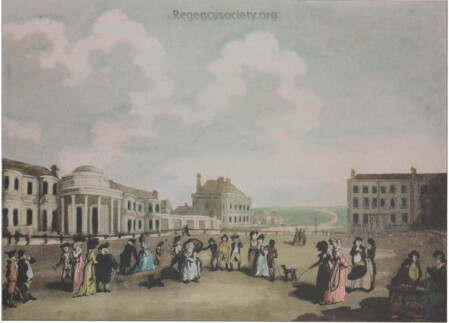
The Old Steine c1800
By the 1780s, Brighton had every facility a visitor expected, and, over the following thirty years, development consisted of enlarging existing facilities and building new. The amount of available resort accommodation in the original town had been exhausted by 1800 and the building of new resort accommodation around the Steine and along Marine Parade then began.
When new buildings were needed or existing ones extended, opportunities existed for developers. In Brighton there were two main types of developer. There was the local builder who acted as the developer, buying land, and then using his own people or sub-contracting to start development with a few houses, before selling off the rest of the land in plots. The second type of developer was not involved in the building trade, but was someone who purchased land from either one of the original owners of the town’s land or from a builder, and then employed another builder to build houses or get the purchaser to build houses. The money needed to purchase the land nearly always came from money earnt by the purchaser’s business or from a loan in the form of a mortgage. In nearly all these cases, the money came from local sources.
Brighton’s land was identified in a terrier of 1792 as belonging to about a dozen men who acquired the land through family inheritance. These men included the Duke of Dorset, Thomas Kemp, Nathaniel Kemp, Charles Scrase Dickens, Thomas Scutt, Richard Whichelo, John Hicks, Philip Mighell, James Michell, John Ackerman, Stephen Buckall and Joseph Walls. With the exception of the Duke of Dorset, all the landowners were local families and none of them appear in the LBS’s database. As the resort of Brighton developed between 1750 and 1830, these landowners began to sell off sections of land for development but also acted as developers themselves.
The greatest period of the development was after 1780 when new houses, lodging buildings and industrial and commercial buildings were all built, and the development spilled out of the Old Town along the coast and inland into North Laine. It was famous architects like Henry Holland, William Porden and John Nash who developed the Royal Pavilion and its estate, but it was the local trio of Charles Busby, Amon Wilds and his son Amon Henry Wilds who, together with Thomas Read Kemp, were responsible for the grand developments of Regency and Georgian Brighton. The Wilds came from Lewes and were active in Brighton from 1814 whilst Busby arrived in Brighton in 1823.
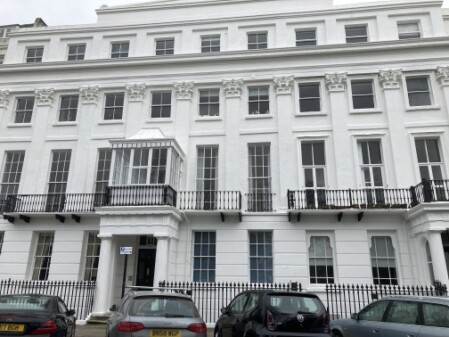
Wilds and Busby were brought together by T.R. Kemp, who had previously employed the Wilds to design and build his grandiose project, Kemp Town, at the east end of Brighton. Kemp Town was the first example of formal town planning in a seaside location. The estate was planned as a great square opening on to the sea, flanked by an elegant crescent. A total of 250 houses were planned although only 106 were built. [The remainder were to have been built as a series of terraces to the rear.] Kemp played a central role in the scheme, but the Wilds and Busby were employed to lay out the site and prepare plans for the elevations.
Thomas Read Kemp was the son of Thomas Kemp who was one of the largest landowners in the parish of Brighton. Thomas Read was born on 23 December 1782 at Lewes. His father rented a farmhouse to the Prince of Wales which was demolished and rebuilt as the Marine Pavilion. Thomas Read graduated from Cambridge in 1805 and the following year married Frances Baring by whom he had four sons and six daughters. Following his father’s death in 1817, Thomas Read inherited his father’s estate and won his father’s former parliamentary seat of Lewes. He lived at Herstmonceux Place from 1807 until 1819 when his family moved to their new house of The Temple, off Montpelier Rd. He was returned to Parliament again in 1823, first for Arundel and later for Lewes.
It was in 1823 that Kemp conceived the idea of a vast 40 acre estate in east Brighton, as an investment to increase his finances. Building started in 1823 on Arundel Terrace and then later on Sussex Square and Lewes Crescent, with the first houses occupied in 1826. He paid for the construction of 92 houses, which were completed by 1828, but then fell into financial difficulties. In 1830, Kemp left England to escape his creditors. In 1842 much of his land was auctioned and in January 1844 a declaration of outlawry was pinned on the door of St Peter’s Church following his failure to defend a suit brought by the architect Sir William Pilkington. He had been ruined by the building of Kemp Town.
It was not until the 1840s that sufficient houses were completed to ensure the viability of the whole scheme. By this time, Thomas Read Kemp was in France where he was to die in 1844. Although a grand scheme, Kemp was to get a minimal return on his investment. He was forced to give away part of his land holdings in Brighton to Thomas Cubitt, to whom he owed money. London builder Thomas Cubitt was eventually elected to the Management Committee, after which he became the driving force in getting the scheme completed.
Despite his financial difficulties, Kemp was a generous man, giving away land for the building of the Sussex County Hospital, land for a Jewish cemetery in Florence Place and giving The Level to the people of Brighton.

Kemp Town, on Brighton's east cliff
T.R. Kemp may have been bankrupted by the building of Kemp Town but the principal architects he employed, Amon Wilds and Amon Henry Wilds, remained in Brighton and the town became their life’s legacy. The father and son moved to Brighton in 1815 and, in 1817, designed and built the Trinity Chapel in Ship Street for Kemp. Two years later, Kemp commissioned the pair to build The Temple, his new home in Brighton and now home to Brighton & Hove Girls’ School. The Wilds contributed to the development of Regency Square between 1818 and 1828, financed by Joshua Hanson, and then part of Richmond Terrace. In 1820, Amon Henry designed the Unitarian Chapel and, in 1825, Amon designed the Congregational Chapel in Union Street. Whilst these buildings were being designed and built, the pair were involved in the building of a number of houses in Marine Parade, in the Steine and in Richmond Terrace. The way they bought up land and then developed it was typical of the way in which development took place in Brighton. Hanover Crescent (1814), Montpelier Crescent (1843), Park Crescent (1849), were others designed by the Wilds. In 1822, the Wilds joined forces with Charles Busby on his arrival in Brighton. Whether this was at the instigation of Kemp we do not know. Busby was born in London, the son of a famous musician and author. He had a talent for art and exhibited at the Royal Academy when just thirteen and, when he was 19, he was awarded the Gold Medal of the Royal Academy School. A year later in 1808 at the age of 20, he published his first book, ‘A Series of Designs for Villas and Country Houses’. He published a second book on designs for chimneys, folding doors and verandas in 1810, designs which were later to be used by Busby and the Wilds. He won a competition to build Bristol’s Commercial Coffee Rooms in 1810 and, in 1813, designed and built the Episcopal Jews Chapel in Bethnal Green. In 1814 he was declared bankrupt and he left for America, where he stayed for six years. Having returned to London in 1820, Busby had a number of setbacks and decided to try his luck in Brighton, the fastest growing town in the country.
The Wilds and Charles Busby were all involved in the first grand development to the west of Brighton on land that was part of the Wick estate owned by the Revd Thomas Scutt. In the 1820s, Scutt decided to capitalise on the expansion of Brighton by selling off land. The idea for the whole project came from Busby, who exhibited his design at the Royal Academy in 1825. The scheme, the building of a community for the wealthy elite who visited or resided in Brighton, was known as Brunswick Town and completed between 1824 and 1830 by Busby in conjunction with the Wilds. The development consisted of four terraces, two facing the sea (Brunswick Terrace) and two facing each other around a rectangular square (Brunswick Square). The Square was largely for purchase by owner occupiers whilst the Terraces opposite the sea were mainly for rental for the season. Work on the eastern section of Brunswick Terrace began in 1824 and was finished in 1828, although many houses were occupied before that date. The Square was started in 1825 and with a few exceptions was completed by 1828. In addition to the high end housing, there was secondary housing in the neighbouring streets, together with a market and a church, hotel and baths. Many of the 75 people linked to Brighton and Hove on the LBS database lived for periods of time on the Brunswick estate but were in no way responsible for its initial development.
If Georgian Brighton had been built on ‘slave money’, then it could be expected that the Wilds, Busby and TR Kemp were the beneficiaries of the slave trade in some way, or that those taking out the long leases associated with the development had links with the slave trade. I have found no evidence thus far of any ‘slave money’ in this development. A search of the LBS database using their search facility has nothing for these names. If, as the University of Brighton article Reparative Histories claims, “colonial wealth extracted from the other side of the Atlantic, [is]congealed in the city’s brick and flint”, it would be expected that the men who had a major part in the development of Georgian Brighton would be found in the LBS database or that there would be evidence available to suggest that they had an income deriving in part from the slave trade. There is no such evidence and, when asked, the lecturers who produced Reparative Histories failed to provide any specific evidence relating to these developers/architects.
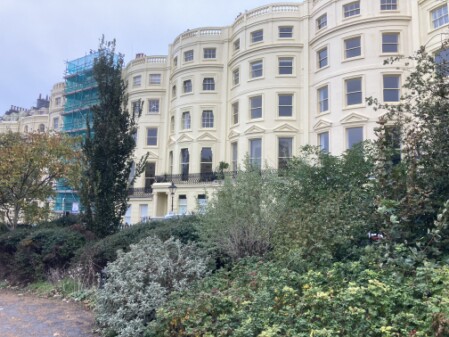
There is evidence though, that one of Brighton’s famous terraces was built by someone who had links with the slave trade. Royal Crescent was built 1799-1802 for J.B. Otto, described in Pevsner’s guide for Brighton by N. Antram and R. Morrice as a West Indian plantation owner. This terrace was Brighton’s earliest example of a unified terrace, and was no doubt inspired by the crescents of Bath and Buxton. When it was built, the Royal Crescent stood in splendid isolation and Otto may have wanted to make the terrace as grand as possible to attract investors.
Following the arrival of the railway in 1841, Brighton began its transition from an exclusive Georgian resort into one that was more popular. It did, though, remain popular with the wealthy and aristocratic elite, drawn to the town as a place for retirement. The Montpelier estate, built by the Wilds in the early 1840s, was popular with a number whose names appear on the LBS database, as were the new hotels that were built in the 1860s. The West Pier, opened in October 1866 and close to the Brunswick and Montpelier estates, was a popular place to promenade for the middle and upper classes. By the 1860s, there were two seasons for two very different types of visitors with the fashionable season moving from the summer to the autumn and winter. For the wealthy elite, Brighton was popular as a place to escape the pea soup fogs of London and to experience the clear sea air. What Russell had done to popularise Brighton as a seaside resort in the 1750s, Dr William Kebbell did in the 1860s with his book, ‘Climate of Brighton’ published in 1859. Kebbell claimed that the climate in Brighton was one of the best in the world.
He wrote
“I am inclined to think that the constant changes of climate at the sea-side caused by the changes of the winds, which bring a marine, or land atmosphere, according as they blow from the sea or land side; and of this place in particular in its dry soil, and the unusual freedom of its atmosphere from anything approaching to malarious emanations, have not been estimated at their due value.” Kebbell claimed that the sea air in Brighton was particularly beneficial to children, “a suitable place of residence for children, as is evidenced by the extraordinary number of schools which are established in the place, and the crowds of children which daily, in fine weather, throng the beach”. “Sea air invariably agrees with children; and the dry bracing air of Brighton, the quickness with which the moisture dries up after rain, enabling them to be a great deal out in the open air, gives it an advantage in this respect possessed by but few other places in the country.”
With the approach of autumn, the large furnished houses in the fashionable terraces and squares of Brighton and Hove found tenants amongst the nobility and the gentry, and a glance at the Brighton Gazette for any week in November and December in the 1850s and 1860s would read like a page from Debretts. Many of those who benefitted from the compensation pay-outs of the 1830s as well as those who were named in the LBS database as executors, trustees, mortgagees and failed claimants visited Brighton and Hove during this time and they came to a place that was regarded as good for their health.
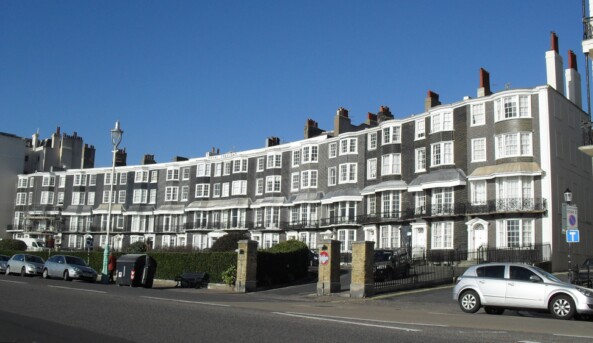
The Royal Crescent