





The Role of the West India Regiments
Cromwell sent soldiers to the Caribbean
In 1654 Cromwell sent soldiers to the Caribbean to capture
Spanish territories-soldiers that had been recruited in England and also in the
Caribbean colonies. They arrived in Jamaica on 10 May 1655 and the Spanish withdrew.
These soldiers were then given grants of land, becoming the first English
settlers in the area settling on other islands as well as Jamaica.
The Caribbean became during these years a cultural melting
pot as wave after wav of forced and voluntary labour arrived, initially to mine
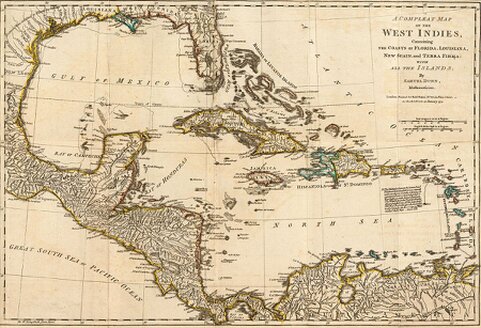
for gold but later to work on the sugar plantations. The Caribbean was the scene of much fighting between the
European powers in the late 16th century a(the
nine year war of 1688-1697) and for much of the 18th
centuries (Seven Year War from 1756-1763 and the French Revolutionary Wars
1792- 1815).
<
>
Disease was a fequent killer
Living and fighting in the Caribbean took a heavy toll on those involved, and death from disease was frequent. Wars had to be quicky concluded before the onset of disease, and it became clear that British regiments fared quite badly in the conditions.
When British army officers realised that black troops did not succumb to disease as quickly as the European troops, they began to consider creating permanent regiments of black soldiers. During the French Revolutionary wars regiments of black slaves were created, despite the opposition of plantation owners fearing that armed black soldiers might pose a threat to European society.
13,000 slaves were bought for the army
The West India Committee, a lobby group based in London to
represent planters’ interests tried to persuade the British government to
reject the plans. However, their pleas were cast aside and the planters
themselves eventually agreed to sell slaves to the army in the West Indies.
Recently arrived slaves were bought by the army for the black regiments and
eventually the army was the largest owner of slaves in the Caribbean, buying
13,000 slaves between 1769 and 1807 when the trade in slaves in British
colonies ended. Once a slave had been bought by the army, black servicemen
had the same rights as their white counterparts and were even protected from
the various ‘slave’ laws.
The British colonies in the Caribbean were defended against
invasion and from any slave rebellion by the creation of local militia, who were
part-time soldiers. Slaves were excluded from these militias but sometimes
there was the need to create a special temporary force and slaves were
occasionally used. This often resulted in the slave being granted his freedom.
The legal status of the black ‘slave’ soldier was debated
with the prevailing view being that black soldiers remained slaves. Fear of
returning to slavery after demobilisation resulted in a number of mutinies in
the years before 1807, with one regiment the 8th being disbanded
when they were ordered by the Governor to clear brushwood. The soldiers were
sent to other regiments, but the debate over the legal status of black soldiers
continued until the Mutiny Act of 1807 made it clear that soldiers of the West
India Regiments were free men.
The regiments fought in many campaigns
The West India regiments proved their worth on the
battlefields against the French and the Dutch and enabled the British to
establish control of the Caribbean, and of the world’s sea lanes. In particular
the West India regiments were involved in the campaigns in St Martin in 1801,
Surinam in 1804, and the defence of Dominica in 1805. The West India regiment
also took part in the 1812-1814 war against the United States. The regiment was
also involved in the defeat by the US in New Orleans in 1815 when lack of
blankets and warm clothes exposed the men to extreme cold. The 2nd
Regiment also fought in Georgia in 1815. During these campaigns over 2,000
American slaves escaped to the British lines and a number were recruited as
free men into the West India regiments. West India men also took part in
dealing with an insurrection in Guadeloupe in 1815 prompted by the escape of
Napoleon from Elba.
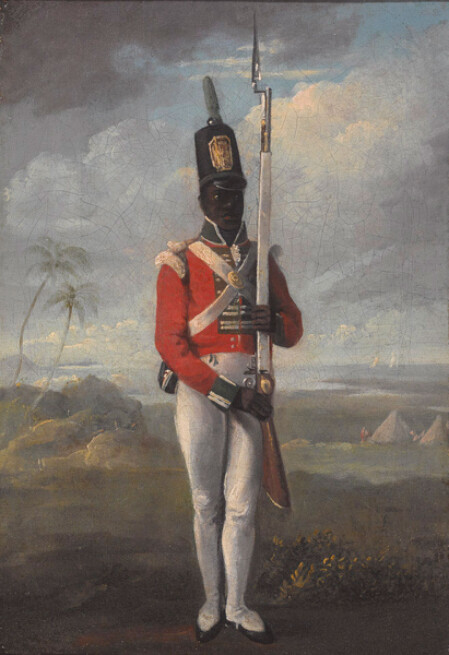
A soldier of the 8th Regiment
They served in South America and Africa
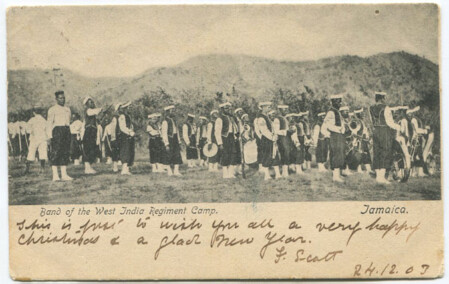
From the 1820s the West India regiments were divided between the Caribbean and West Africa until their disbandment in 1927. They were involved in putting down local unrest in Caribbean islands, including the slave rebellions in Barbados in 1816 and Demerara in 1823. Being a soldier in the British army gave a certain status which helped to maintain loyalty, although after the Abolition of Slavery in 1833 there were tensions between plantation owners and black soldiers, however the soldiers remained loyal to their regiment.
When there was violence in Jamaica in 1865, soldiers of the 1st West India regiment was involved in the brutal response of the British army. Although soldiers were required to hang and destroy the homes of Jamaicans, the soldiers did not hesitate to obey their orders.
West India regiments also served on the South American mainland.
In September 1872, 38 men of the 1st West India Regiment were attacked by 180 local Icaiche Maya men. They held out of six hours, repulsing the enemy, and a number of soldiers were awarded medals.
The 'Hut Tax War'
The West India Regiments also served in a number of campaigns in West Africa in what is now Ghana, Gambia, and Sierra Leone. In 1869 following the establishment of a protectorate in Sierra Leone, and the imposition of taxes and a ban on slavery, there was discontent and 1,100 West India men took part in the so-called ‘Hut Tax War’.
The Ashante Wars
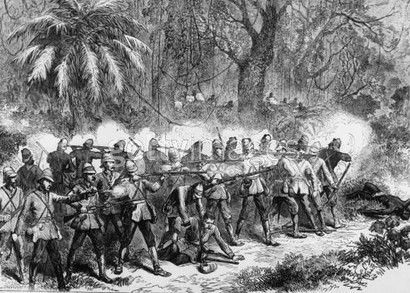
Several wars were fought against the powerful Ashante Confederacy, including the 3rd Ashante War (1874/5) in which they had to resist attacks from the Ashante for six months until General Wolseley arrived with reinforcements. The West India men then took part in Wolseley’s attack on the Ashante capital, Kumasi.
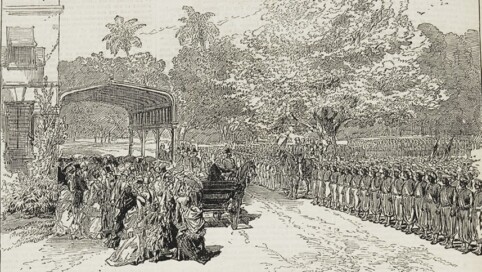
West Indian soldiers during the Ashante campaign of 1874-75
The West India Regiments served in West Africa and Palestine
in World War One but in addition thousands of Caribbean men volunteered for
service by travelling to Britain and joining regiments. Caribbean governments
supported he creation of a new fighting force to which King George V gave his
agreement and he British West Indies Regiment was formed an over 15,000 men
enlisted to provide logistical support on the Western Front.
Disbanded in 1927
The West India Regiments were disbanded in 1927 but following the beginning of World War Two, Caribbean governments and the Colonial Office lobbied for the creation of another military force. In 1944, the Caribbean regiment was formed, comprising 1,200 volunteers. It went through its training in Virginia in the US before embarking for Europe where the regiment took part in guarding the Suez Canal. 600 Caribbean women, both black and white , also joined up to serve in the Women’s Auxiliary Territorial Service, serving in a variety of roles during the war.
The West India Regiments were reformed in the 1950s when there was a brief attempt to create a West Indies Federation, but its collapse meant the end of the West India Regiments. Many of the demobilised men did though join local defence forces, including those in Trinidad and Tobago, and Jamaica. West Indians continue to serve in the British forces, being recruited in the Caribbean or from the local Caribbean community in the UK. The defence forces in the Caribbean continue to have links with the British army and recently two territorial units in the Turks and Caicos and the Cayman Islands have established links.
Further reading:
National Army Museum exhibition
Related Pages