



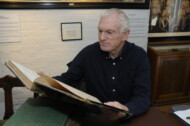
Thomas Baines
Painter and Explorer
Cape Town
Thomas Baines is best known for his paintings and sketches of South African and Australian colonial scenes. Much of his work was done whilst taking part in expeditions to explore parts of northern Australia and South Africa and in the case of Australia determine the suitability of the land for colonial settlement.
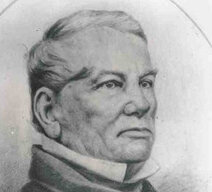
Baines was born in King’s Lynn on 27 November 1820, the son of a master mariner and a mother who herself was the daughter of a local painter and decorator. Thomas’s mother was the driving force in the family and the one who educated Thomas in drawing and painting from an early age. His fondness for painting continued until at 16 he was apprenticed to a carriage painter. When he had completed his apprenticeship at the age of 21, Baines decided to travel. Having been refused the hand of marriage by his cousin Emma was perhaps a factor in his decision to go abroad. He made the decision to go to Cape Town having heard much of the town from his father who painted an idyllic image of the town. Baines left for South Africa aboard the ‘Olivia’ which was captained by a family friend.
Painting in Cape Town
Baines had little money and had to travel steerage class as there was no government scheme to help him migrate to South Africa at that time. On arrival at Cape Town on 23 November 1842, he remained aboard the ‘Olivia’ for a week to save himself some money. The captain had seen some of the work Baines had done during the voyage and felt sure he would find work which once ashore he did quite quickly. He did not last long at his first job as he found irregular work as an assistant to a coachbuilder. The flexible nature of his work meant that he had free time to do his own painting.
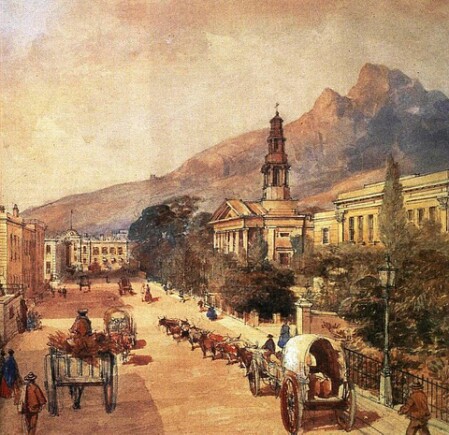
St George's Cathedral, Cape Town
Thomas was a regular church goer, and he was soon asked to paint the church. This proved successful and he was soon being offered so many commissions that he was able to give up the job at the coach builder and paint full time. He began by specialising in marine subjects and portraits and was fortunate in being in Cape Town where there were plenty of marine scenes and people wanting their portraits painted. He soon became irritated with the demands of his clients and painted an uncommissioned painting of a scene in the Kaffir War then taking place in the Eastern Cape. He decided to venture out on his own into the Eastern Cape. He travelled to Grahamstown, on the border with the lands of the Xhosa people, sleeping rough when he wasn’t able to take advantage of taking shelter with an army patrol.
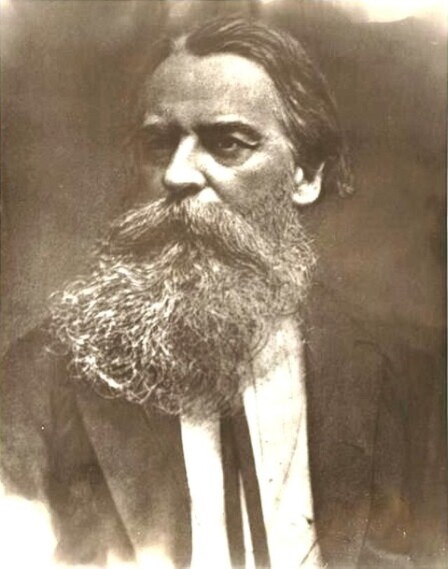
His paintings were greatly admired although he wasn’t able to sell enough to pay for his food and lodging so when the opportunity to paint scenes for the army was offered, by officers of the Highland Regiment, he took the offer of work and painted scenes from the ongoing war. Baines was in the Eastern Cape for three years between 1848 and 1853, from where he undertook three journeys into the interior. He travelled beyond the Orange River and the Kei River and during his time painted scenes from the Eighth Frontier War (1850-1853).
Scenes fom the Frontier Wars painted by Baines
The quality of Baines’s work reached the attention of people back home in England and he started producing work for the Illustrated London News, although his work was published anonymously. His mother though helped Baines establish a reputation and got the Queen to acknowledge his work. Despite his success in England, Baines remained in South Africa until he returned home in 1853, at the age of 33. Back in King’s Lynn, Baines organised an exhibition of his work and gave talks on his experiences in Africa. He also published Scenery and Events in South Africa. He was still not making much money from his paintings and when in 1855 the opportunity to take part in the exploration of northern Australia came up, he accepted and joined the expedition as a storekeeper and artist. Baines not only sketched and painted the landscape of the north but helped to map the area for the Royal Geographical Society. His reward was the award of the Society’s Gold Medal in 1858 and election as a Fellow of the Society.
David and Charles Livingstone
Baines was next invited to join David and Charles Livingstone on their 1858 journey to the Zambesi to explore possible sites for commercial development. This was not a happy trip as the Livingstones were not easy to work for. Arguments with David Livingstone’s deputy, a Royal Naval officer, Commander Bedingfield, eventually resulted in Bedingfield leaving the expedition and Baines had to take on more responsibility. This brought him into more contact with Charles Livingstone who was idle and seemingly determined to destroy the reputations of Baines and Bedingfield. Charles accused Baines of theft and his brother David accepted his version of events. Baines was dismissed and Baines set out on his own to see South West Africa and the Victoria falls where he had hoped to meet David Livingstone to clear his name. He did though paint many of the landscapes which helped to make his reputation in later years. His trip was cut short by a bout of fever, and he returned to Cape Town from where in 1864 he returned to England.
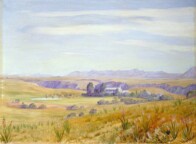
Scenes from Baines's trip to South West Africa and the Victoria Falls
Baines returned to South Africa in 1868 and led an expedition on behalf of the South African Goldfields Exploration Company to the land of the Matabele, north of the Transvaal. A German geologist named Mauch claimed to have discovered gold in Mashonaland in 1867 and also identified another gold reef at Tati, close to the lands of Mzilikazi, the leader of the Ndebele people in Matabeleland. Baines had been tasked with getting a permit from Mzilikazi to prospect for gold, but Mzilikazi died before he reached him. He was though granted a concession to explore for gold by Mzilikazi's son, Lobengula, In 1873 Baines was still amongst those looking for gold in South Africa and visited the area around Natal to investigate the possibility of gold, and also attended the coronation of King Cetewayo. Baines remained in South Africa and was writing an account of his travels when he fell ill and died in Durban on 8 May 1875.
<
>
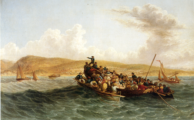
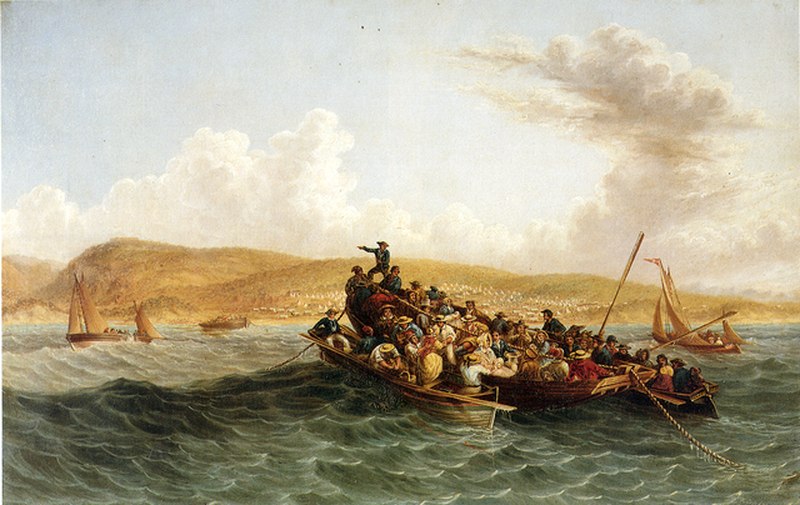
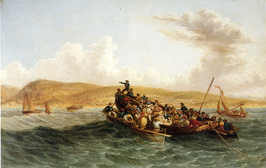
The Landing of the 1820 Settlers in Algoa Bay, 1820 by Thomas Baines
Baines, through his paintings and sketches of life and landscape in Australia and South Africa, provided an insight into colonial life and the harshness of the landscape. His scenes of the Frontier Wars emphasised the difficulties of settlement in the Cape Colony and he was probably the first person to paint Victoria Falls.
Peter Crowhurst, February 2024
Further reading:
The Making of South Africa by Martin Meredith, 2007