The Asante were the most cultured tribal grouping on the west coast of Africa. By the mid-
All trade was organised by state agencies and there was a state bureaucracy to govern and collect taxes. The roads of the Asante were well maintained and having an economy based on gold, the kingdom was wealthy. According to the website ‘Modern Ghana’ “the most prominent historian of Asante, Ivor Wilks, has suggested that while some farming on a very limited scale had probably been practiced in the Ghanaian forests for millennia, only when the Akan began importing slaves in the 15th and 16th centuries were they able to shift from an economy which relied primarily on hunting and gathering to one which became primarily agricultural. As this transition to agriculture took place, Akan communities not only planted more of their traditional crops -
In the c16th there were at least 38 states in the Akan region (largely southern modern day Ghana) but by the c18th there was only one state, the Asante and they reigned supreme in the region until confronted by the British in the mid-
The Asante had a fearsome reputation as fighters and resented the British presence along the coast of west Africa. There was a thriving economy based on gold, slaves and agriculture before the Portuguese arrived in 1482. Slaves were acquired by the Asante to work their fields and much of the original slave trade was between European slave traders and African purchasers. Only later did the Europeans begin to send slaves to the Americas and by the time that the British abolished the slave trade (for their ships) at least twelve million Africans had been sold to American masters.
The Portuguese were the first to establish a trading fort on the west coast of Africa but as the British came to dominate the slave trade and indeed trade generally to and from west Africa they began to take over forts established by other European powers and regard the coat as a British protected area. There were periodic attacks on these forts by the Asante and following attacks on the ex-
Arriving at the Cape Coast Wolseley found just twenty two British soldiers fit for duty from the garrison of a hundred and thirty and there were just four days of supplies. In the armoury there were just four hundred Lee Enfield rifles and nineteen Snider rifles. Enquiring about the nature of the terrain further north, Wolseley discovered that there was little known about the area and no maps available. Wolseley had hoped to build a railway into the interior but did discover that the interior was a land of deep gullies and hills – not at all suitable for a railway.
A feature of this campaign was that correspondents would accompany the expedition. There were some famous names among those correspondents who accompanied Wolseley who tried to ensure that they had everything they needed. There was Winwood Reade of the Times, GA Hentry for the Standard, Melton Prior for the Illustrated News and Henry Stanley for the New York Times. Wolseley realised the importance of the new journalism and the audience of these journalists who provided favourable reports of Wolseley’s leadership and the nature of the operations. The British actions were to read like the exploits of a later Henty novel as the British soldiers were portrayed as knights in armour fighting to extend the empire and civilisation whereas the Asante were shown as barbaric and devoid of culture.
On 13 October representatives from Wolseley informed King Kofi of the Asante of the terms for peace. He was to withdraw from the British protected area by 12 November, release all prisoners and pay an indemnity of gold. The king was also told that if he refused the terms then the Asante would be removed from the British protected area, his won territory would be invaded and his capital Kumasi destroyed.
Wolseley began his campaign against the Asante by removing them from the coastal villages that they controlled. He did this by using locally raised militia from the Hausa and Fanti tribes but discovered that although the aims of the initial campaign were achieved, the coastal tribes were not good fighters. Wolseley regarded the Hausa as having plenty of pluck but wild and the Fanti as being cowards. He thought the Asante as brave and worthy opponents. Consequently Wolseley decided that he should needed to use the British troops that he had been promise should he need them.
To try to minimise any British losses, Wolseley made certain preparations. He had special uniforms devised that were loose fitting, he had cork helmets designed and he ordered that quinine be taken before each day’s march. Wolseley had a road built to cover half of the journey to Kumasi with resting places with huts on stilts and hospitals. The desertion rate amongst the natives building the road was such that the campaign got behind schedule. The Fanti and Hausa were used in the initial skirmishes and succeeded in forcing the Asante to retreat. During this early stage of the campaign Wolseley had to be carried on a wicker sedan chair as his leg with the wound from the Crimean War was hurting too much. During this early stage the British troops we kept aboard ship and sent on a little cruise to keep them away from the malarial coast until they were needed.
One the main part of the campaign started, Wolseley divided his forces into four columns with the British troops in the central column led by himself. He was criticised for dividing his forces and putting the lives of the men under his command at risk by Winwood Reade. Just over five years later Chelmsford was heavily criticised by Wolseley by dividing his forces into three columns in south Africa but the difference was that Wolseley got away with it whilst Chelmsford had one of his columns completely destroyed at Isandhlwana.
The Asante War of 1873-
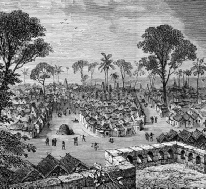
Coomassie, capital of the Asante land

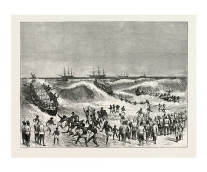
British Troops landing


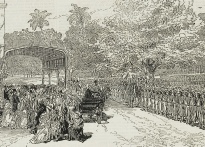

Various scenes from the Asante War including West Indian troops landing and a Highlander
1815-1914
