1815-1914

Egypt 1881-
In 1869 the Egyptian-
The stability of Egypt was crucial to British strategic interests in the Middle East, and the ambition of Khedive Muhammad Ali seemed to be taking Egypt towards becoming a modern state. There had been investment in railways, cotton plantations, and irrigation as well as schools but by 1882 total debt totalled £100 million. Despite attempts by an international commission to keep the country solvent, internal dissension with international interference led to unrest and a revolt by army officers in February 1881 led by Urabi Pasha. In September 1881 he carried out a coup d'etat and made himself Minister of War with full control of the army.
The British were concerned at the possibility of an anti-
During August two armies, one of 24,000 troops from India and one of 7,000 from Britain and led by Wolseley converged on Egypt. Warships occupied the canal and the military force landed on 18 August at Ismailia. Four weeks later Urabi's camp at Tel-
Second Anglo-
In 1897 Lord Milner was appointed High Commissioner for South Africa. Already relations between Britain and the Boer republics were poor as a result of the Jameson Raid -
In May 1899 the Cape PM, Schreiner and Hofmeyr, leader of the Cape Afrikaners, proposed to Milner that he should meet with Kruger to try and settle matters and so on May 30th Milner found himself steaming north to Bloemfontein to a conference with Kruger. He was determined that it should not succeed.
By this time the 'uitlanders' were paying 5/6th of the country's taxation, were the majority of the population but had no representation. At the conference, Milner was to push for a five year franchise, retrospective, which Kruger resisted until the last day when he agreed but with conditions. Kruger wanted in return negotiations on the Raid indemnity, Boer control of Swaziland and arbitration on rival interpretations on the London Agreement of 1884. The extra conditions were all that Milner needed to end the proceedings. Kruger's comment on the failure of Bloemfontein that what Milner wanted was not the franchise but his country.
In August clutching at straws, the Boers offered a 5 year franchise but still with some conditions including the non-
Kruger decided that war was inevitable and as the Boers had the numerical advantage in October 1899 of 40,000 to 15,000, it was hoped that if they could struck a swift blow they might force the British to the table at which they would acknowledge the full sovereignty of the Boer republics. By throwing all their troops against Natal, they could capture Durban before the first ships brought reinforcements, and this would encourage the Cape Afrikaners to rise up. On 28 September the Transvaal mobilised followed by the OFS on 2 October.
On 9th October Kruger sent the British government an ultimatum demanding that the British withdraw their forces from the Transvaal border and send back forces on the way (8,000). When this ultimatum expired on 11th October the two sides were at war.
Wars of Expansion
1881-
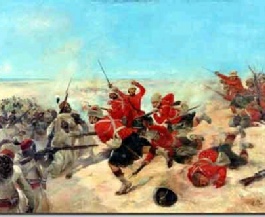
Battle of Tel-
Boer commandos
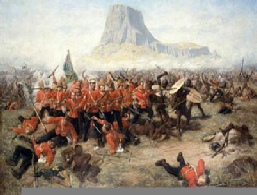
Volunteers played an important [part in the British army in South Africa