1815-1914

Key Feature of the 19thcentury British Empire,
part two
How was the British Empire ruled?
The British Empire that Victoria inherited had no coherence or philosophy undermining it. The territories of the empire had little in common apart from that they were administered by the British. There was no central organisation keeping an eye on what was happening: indeed the Colonial Office did not become a separate office of state until the 1850s and even then it had about one member of staff for each of its territories. Ronald Hyam in his book ‘Britain’s Imperial Century’ described the empire as ‘a rag bag of territorial bits and pieces’ and representing ‘at best only a dominion of opinion and a grand anomaly, and at worst a temptation to illusions of grandeur and a gross abuse’. For Hyam the empire was ‘a set of aspirations and activities only loosely held together, chiefly by the defining limits and overshadowing realities of ‘he American republic and the Indian Empire.’ Adam Smith wrote how the empire was not an empire at all ‘but the project of an empire’. The empire was different things for different people and its territories were acquired for different reasons.
Until the late c19th, there was little in the way of central control as the government did not possess the means or the money or indeed a coherent policy. Within the government there were various persons that had some responsibility for aspects of colonial rule – the Prime Minister, the Foreign Secretary, the Secretary of War, the First Lord of the Admiralty and the Secretary for India – making it difficult to bring about any kind of continuous policy. The Colonial Office had only been given a seat in the Cabinet in 1854 and the department of state did not interest most politicians at all. Its role was to administer the colonies as cheaply and as efficiently as possible.
Reporting to and responsible to the Colonial Office were the 300 governors, lieutenants governors, administrators, high commissioners and presidents who ruled their colonies on behalf of the British government. Most were from the ranks of the middle classes who had connections and were able to use the patronage of the day to secure an appointment. In most cases they operate on a limited budget and did their best to rule efficiently and justly and act as referee between different competing interests. Often it was the colonial governor who acted to protect the local people or indentured workers from businessmen who sought to exploit them.
These governors, the men on the spot, acted on their own initiative, and sought to improve their colony by introducing aspects of British civilisation – roads, railways, hospitals and institutions of education and government. Men like Frank Swettenham in the Malay States and William de Voeux in St Lucia and later Hong Kong, were men of integrity who worked hard to do his best to improve the condition of the local people although in doing so it usually meant introducing western capitalism and British values and customs.
The imperial government struggled to exert its authority, even after the telegraph had been introduced, and imperial administration owed much to the men on the spot to do their imperial duty as they had been brought up to do. These men on the spot understood the realities of the local situation and needed to gain support and admiration from local elites. They were a particular feature of the British Empire that made it different from other European empires. Rather than there being one empire it could be said that there existed a hundred empires, each one administered by a British civil servant running his territory in the best way that he could.
The Importance of Force and Violence to the British Empire
Although the British were to justify their conquests by claiming that there was a philanthropic motive, there is no doubt that war was crucial to the way in which the British Empire expanded, particularly in the Victorian period. Wars in Afghanistan, India, China, Burma, Egypt, Sudan, New Zealand, Canada, west Africa, south Africa were all important in establishing British control and influence. To establish a colony and then control it required the subjugation of the local people. Sometimes the local population were not necessarily a martial race and did not possess the resources or knowledge to fight a British invasion force and annexation was relatively easy without great loss of life, but a martial race like the Maori in New Zealand or the Xhosa in south Africa had to be persuaded to give up their sovereignty. This was usually done by signing an agreement which allowed the British certain rights which the British would later ignore once a British settler population had been established. Even after the British had established nominal control of a territory, there was always the possibility of resistance to the way the British governed. The British government was not in a position to have garrisons in every colony so compromises had to be negotiated with local elites but if the British alienated the local elites who the British relied upon, there was the possibility of violence.
In the late 18th century there was an evangelical revival which led to the formation of the anti-
Queen Victoria became Queen in 1837 as the British Empire was developing a moral dimension. As the country moved towards democracy and a fully industrialised society, the one thing that was generally agreed on about the empire was that the empire was a powerful force for the spread of civilisation through trade and the imposition of superior codes of behaviour. There was debate about how territories should be run and how natives should be treated but universal agreement that native peoples could benefit from being part of the British Empire.
The idea of the mission had been present from the 1740s but foreign missionary work was controversial for much of the c18th as it was thought that native peoples had to acquire elements of civilisation before they could be converted to Christianity. By the 1790s though, a more optimistic view of missionary work had been accepted. It became accepted that salvation was available for all and only depended on receiving the word of God. How could one deny sharing the knowledge of God and leaving millions in a state of ignorance?
With this view becoming prevalent a Protestant missionary movement was established in the 1790s at the same time as the campaign to abolish the slave trade was gaining strength. An early missionary society was the Baptist Missionary Society founded in 1792 followed by the London Missionary Society, established in 1795.
Missionaries believed in the power of the word of God and that all they had to do was to reveal God's word through preaching. With the expansion of the empire into the Pacific and Africa, and the opening up of India to missionaries, these societies opened up numerous missions around the world at the beginning of the c19th. Native peoples were regarded as heathens and providing opportunities for missionaries to achieve their own salvation through the saving of others. Conversion was the highest form of service and as the empire expanded more opportunities became available for those wishing to find redemption and salvation. Development of the missionary movement accelerated during the 1830s following the freeing of slaves in the empire and by the end of the century there were ten thousand men and women missionaries working throughout the world. It was this ideology – the Mission to Civilise -
In the period after 1870 a new aggressive form of Imperialism termed New Imperialism developed as a response to the emergence of European rivals and the USA. Following the emergence of unified countries in Italy and Germany in 1870-
Britain responded to this global challenge by strengthening its control over states with which it had informal trading arrangements and annexing territories that it believed were in danger of being annexed by a rival European power. Governments became more sensitive to the dangers rivals might pose to British strategic interests and were more prepared to use force to maintain its control as when the French threatened British control of Egypt in the late 1890s when there was a stand-
Imperial Federation, first advocated in the 1870s by Disraeli and Lord Carnarvon, was seen as a way of strengthening the links between colonies of the British Empire, and in 1884 an Imperial Federation League was founded. There were those who wanted to abandon free trade and perhaps introduce imperial preference but Britain’s global links in trade and investment made it very difficult for any government to move forward on this. Instead efforts were made to improve imperial defence at a time when both the Royal Navy and the army were heavily criticised for being inefficient and not up to the job of defending Britain should Britain come under military threat.
In the period 1815-
White settlement often meant the subjugation of indigenous people either by forcing them off their land, by buying their land or by killing them and taking their land. Settling in to a new land was difficult and the remoteness of colonies encouraged self reliance and self determination. By the end of the century though the settler colonies were making a significant contribution to Britain's economy and two thirds of the English speaking people living outside Europe.
Until the British Empire began to become a focus for politicians and the general public after1870, the British had little concern or appreciation of the Empire or for those who had settled within it. Yet migration was a crucial part of British Imperialism. In 1882 Sir John Seeley, Professor of History at Cambridge wrote a bestselling book, 'The Expansion of England' in which he argued that the empire was the source of Britain's strength and its expansion was vital for Britain's continuance as a great power. Writing not long after Darwin and Herbert Spencer who coined the phrase 'The survival of the fittest' Seeley argued that if Britain continued to expand her colonies then Britain could hold her own.
The Illusion of Power
One of the achievements of the British Empire was that it disguised the real state of British economic, military and naval power. The Empire gave the illusion of power yet the reality was quite different. From the time the US Civil war ended in 1865, Britain gradually lost her pre-
Peter Crowhurst, March 2018
Further Reading:
- Empire by Niall Ferguson, 2004
- The Rise and Fall of the British Empire by Lawrence James, 1996
- The Decline and Fall of the British Empire by Piers Brendon, 2008
- British Imperialism by Robert Johnson, 2003
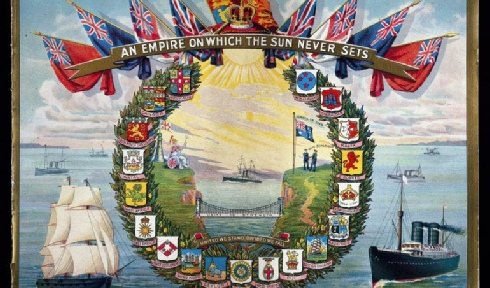
The British Empire had no coherence or philosophy underpinning it. It was conceived for a variety of reasons and often without the blessing of central government.
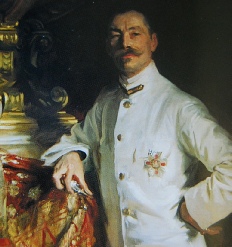

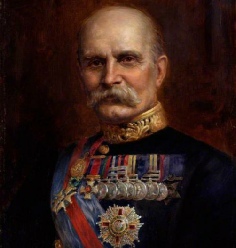
Men like Frank Swettenham, William des Voeux and Frederick Lugard devoted their lives to the British Empire.
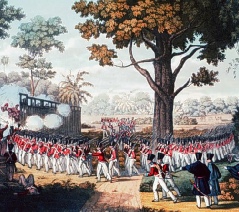
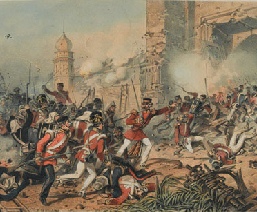
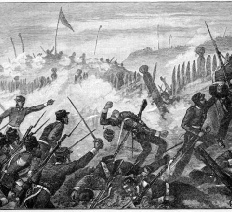
Burma, (left), India (centre) and New Zealand were all added to the Empire through the use of violence as were virtually all of Britain’s colonies.
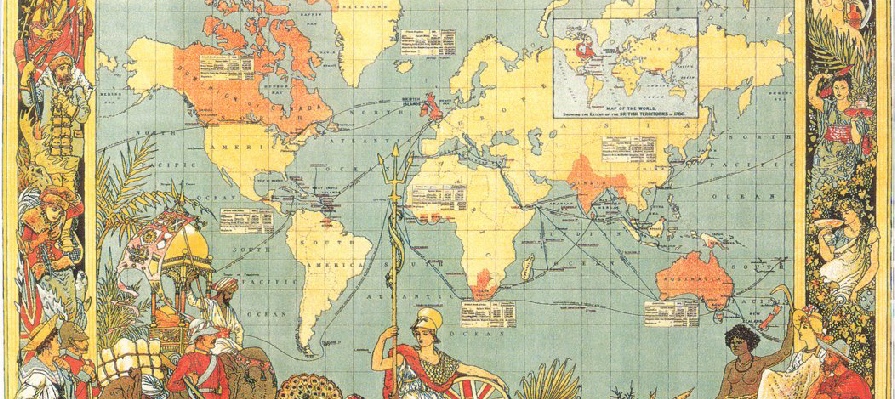
This map was produced by Walter Crane for the Indian and Colonial Exhibition in 1886. It was used by the Imperial Federation League to promote their cause.