1815-1914

Why did Britain go to war against Germany in August 1914? Part 3

The Schlieffen Plan
Germany's war plan, popularly known as the Schlieffen Plan after the Commander in Chief of the army up to 1905 has been the subject of a great deal of debate by historians. All countries had developed war plans for the eventuality of war but it has been the German plan that has come up for greatest scrutiny. Was the German Plan a cause of war and therefore justified imposing the so called War Guilt Clause 231 with its attendant reparations which so crippled Germany and were themselves a factor bringing Hitler to power.?
All of the various war plans could be seen as advocating wars of aggression and this was certainly the case with the Schlieffen Plan but it was essentially a reaction to the French Russian alliance which sandwiched Germany and left her vulnerable to an attack from both of her frontiers.
The development of war plans had come about as a result of the acceptance by all sides that war was an extension to international diplomacy and a response to the industrialisation of war. The Prussian victory over the French in 1870 had been a watershed in warfare. It had shown that it was possible to have larger armies armed with all the weapons that an industrialised country could mass produce. The German army in 1870 had been taken to the front by train and the train was a key component in devising war plans. Now soldiers could be mobilised quickly and armies could move quickly requiring a quick response from the enemy. By 1897 Germany had 545,000 soldiers in uniform and another 3-
Much of the German war plan was devised by General Von Schlieffen who was head of the German general staff from 1891. Schlieffen devised a plan that would deal with the problem of having an potential on each frontier. The resultant plan was a gamble and made certain assumptions. If any of these assumptions proved false or if something went wrong in the implementation of the plan, the result could be disastrous for Germany. Schlieffen feared a long drawn out war with Russia and France and devised a plan that would deal a knockout blow to France before even the Russians had even mobilised. Schlieffen assumed it would take at least six weeks for the Russians to mobilise as they did not have a good enough rail network to mobilise quickly. Schlieffen assumed that France would place most of her army along the common border with Germany and in the southern part of Belgium. Von Schlieffen believed that Britain would not intervene and that the northern part of Belgium would be poorly defended. It was in this part of Belgium , between Liege and the sea that Schlieffen would focus on. He aimed to move the German armies quickly through northern Belgium and then into northern France. By the time the French realised what was happening it would be too late to take effective action and Paris would have fallen. For this plan to work the assumptions had to hold and the train timetable had also to work. Once the troops began to be mobilised the whole process had to happen quickly. There would be no going back. In his analysis of the causes of WW1, AJP Taylor claimed the railway timetables were as important a factor as any other in bringing about war.
The Kaiser knew nothing of the Schlieffen Plan
All of the war plans were devised by the military and had little civilian involvement or oversight. In many cases there was not even inter department liaison. In Germany the Kaiser did not know of the details of the Schlieffen Plan until told of them by Moltke days before war began. In Britain the army devised plans for the British Expeditionary Force without discussing with the navy how they were to be transported. Given the nature of these plans they assumed a momentum of their own and must be considered factors in bringing about war.
Between 1905 and 1914 there were a series of crises between the European powers, each of which helped to bring war a little closer. In the first few crises the issues were resolved and peace maintained but at a cost. Each crisis left at least one nation feeling aggrieved and perhaps humiliated and with a desire not to let the humiliation happen again. Each crisis reduced the scope for crisis resolution and with the escalation in the size and power of armies and a belief in war as a means of achieving political aims it was only a matter of time before a crisis could not be resolved and war resulted. Certainly Germany Austria-
The Balkan Wars
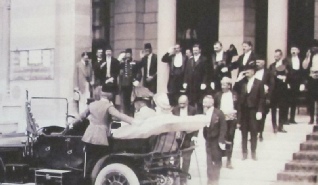
The assassination of Franz Ferdinand which as we know led to the outbreak of WW1, led first of all to the 3rd Balkan War. The first two happened in 1912/13 and could well themselves have led to general war between the European powers. That war did not happen a year earlier in 1913 was due to the restraint imposed on allies by Britain and Germany and the willingness of the European powers to settle disputes through peaceful means as they had been doing for more than a century. But in the process, seeds were laid for war. Serbia came out of these wars emboldened whilst Austria felt isolated, and it seemed as if the art of using ultimatums and brinkmanship had worked. Despite their small populations the peoples of the Balkans were encouraged to take on the Ottomans as a result of Italy attacking Libya in an unprovoked attack in October 1911. It was this attack which gave the Balkan peoples the confidence to attack the Ottoman rule in the Balkans.
Bethman, the German Chancellor and his foreign secretary Kiderlen wanted at first to steer a middle way thorough the Balkan Wars encouraging mediation through international agreements. Germany was at the time in the middle of negotiations with Britain to try to bring about Britain's neutrality in the event of a European war. Kiderlen tried to steer a course between working with Britain to bring about a peaceful settlement of the Balkan Wars and trying to restrain her alliance partner Austria from going too far. In the event the German leaders, including William, did not want to see the destruction of the Ottoman Empire as they had substantial interests there. So eventually Germany gave outright support to Austria although it did not state categorically state what this support consisted of.
The Balkan Wars had finished without any major confrontation but it had left a residue of bitterness and resentment that festered. Serbia was a clear winner and gained not just territory but prestige emerging as the dominant Balkan power. There was talk of union with Montenegro and of a new Balkan League. Serbia's government was incapable and unwilling to rein in the various nationalist groups which were agitating for union of the South Slavs within Austria-
Russia and Russia had both used preparations for war and military mobilisations as tools of diplomacy and believed they had worked and would work again. They had worked this time because the bluffs had not been called and the voices for peace were stronger than those for war. But would such measures work again?
The blank cheque
When the news of the assassination of Franz Ferdinand and his wife on 28 June 1914 was relayed to Vienna, there was universal support within the government for war against Serbia. The Hungarian Prime Minister, Tizsa, would not support war without the support of Germany and no-
The Austrian ultimatum to Serbia
With German's full support Austria proceeded to work out what to do next. Tizsa wanted an ultimatum before mobilisation but although the Germans urged speed, this was not the way the Austrians worked. Eventually an ultimatum was sent on 23 July, whilst the French Prime Minister, Poincare was on his way back from a visit to Russia. The Serb Government was given forty-
When Grey saw the document he described it as the most formidable document he had ever seen addressed by one State to another. Churchill described it as the most insolent document of its kind ever devised. Yet it was a lot milder than the ultimatum presented by NATO to Serbia in March 1999 to force the Serbs to comply with NATO policy over Kosovo.
The Russian response
The Russian response was not as Germany had expected. On the evening of the expiry of the ultimatum, Russia told Serbia it would take it under its protection and would go to any length to protect Serbia. This news probably encouraged Serbia to reject the ultimatum but they produced a response which offered the greatest possible compliance without compromising Serbian independence. The Russians then decided to prepare to mobilise an army of 1,700,000 to go into action as soon as Austria attacked Serbia. On 26-
Germany declared war on Russia
On the morning of 28 July Franz Joseph signed his declaration of war and this was followed on 30 July by full mobilisation by Russia. This was the first of the general mobilisations and came at a time when Germany had not even gone into pre-
The British response
Germany had been hoping to keep the war localised and to emphasise this most of the decision makers in Germany were on holiday, including the Kaiser who was on a cruise in the Baltic. As news came through of Russia's mobilisation, the decision was taken to respond and
In Britain the cabinet had not discuss foreign policy at all since the assassination. It was only on 24 July that the cabinet discussed the crisis and it was only to approve Grey's plan for a four power intervention. Cabinet then broke up for the weekend and reconvened on 27 July when Grey asked the cabinet whether it would support intervention if France were to be attacked. Three of the cabinet threatened to resign (Morley, Simon, Burns, Beauchamp and Harcourt). At a late night session on 29-
At the cabinet meeting on 1 August, the anti-
On 2 August, the German Government issued an ultimatum to the Belgian government. This given the Germans need for a speedy advance through Belgium was a huge mistake. When the ultimatum was answered on 3 August prompting the German attack, which ultimately brought in the British on 4 August.
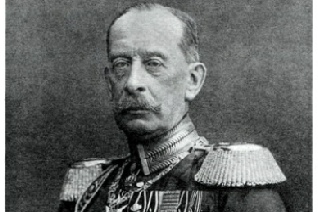
Alfred von Schlieffen

The Schlieffen Plan
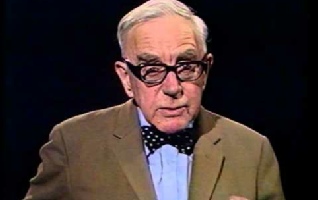
AJP Taylor
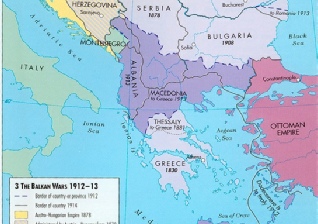
The Balkans
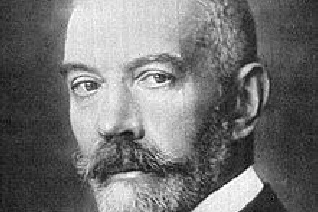
The German Chancellor Bethman Hollweg
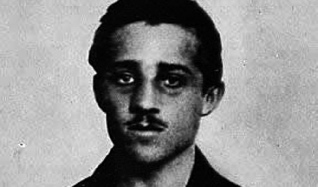
Gavrilo Princip, the assassin
The Archduke Franz Ferdinand and his wife arrive at the townhall in Sarajevo
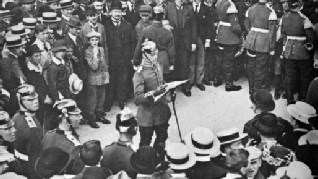
German mobilisation, August 1, 1914
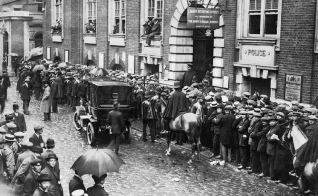
A recruiting office in Whitehall, London, following war with Germany

Britain invoked an 1839 treaty with Belgium to justify war with Germany.