1815-1914

British populations besieged at Kimberley, Ladysmith and Mafeking
Ladysmith
Ladysmith, in northern Natal was the first of three towns that were besieged. Elsewhere in the west of Transvaal, Boer forces advanced upon the strategic towns of Kimberley and Mafeking, both in the very northern part of the Cape Colony. Kimberley was already famous for its diamond mines -
At Ladysmith, maintaining the siege was regarded as an achievement by General Joubert as it meant that the British could not launch an offensive against the Transvaal but the decision has been heavily criticised as a major miscalculation which has been regarded as one of the major tactical errors of the war. The siege diverted thousands of troops from offensive campaigning and kept them idle against the military culture of the Boers. The commandos had not been raised to conduct fixed siege operations and it was not long before Boers were leaving their posts and returning to their farms for the harvest. Joubert was regarded even by many Boers as past his time-
At Ladysmith both sides seemed to settle for tit for tat shelling. the Boers had a number of Creusot guns which fired daily into the town but with little impact. Much of the civilian population had been evacuated into the nearby field hospital at Intombi. The besiegers rarely looked as if they had the will to take the town. As for those inside Ladysmith, despite dwindling supplies and grim conditions which led to about 10 deaths a day, it never looked as if the town was going to be forced to surrender. The Boers encircled the town within a six mile radius but the British themselves constructed a smaller defensive ring. The Boers hoped to starve the British out whilst keeping Buller at bay. What was required was reserves of patience rather than valiant deeds. There was the occasional foray to try and destroy Boer positions but these usually ended with a heavy loss of life. On 6 January the Boers made their only real attempt to break through when they attacked Bester's Ridge. 2,000 Boers attacked the ridge at night but were held off. Fighting went on during the following day but with reinforcements and the use of the bayonet, the Boers pulled back as the next night approached. There had been 400 British casualties with 200 Boer losses.
Kimberley
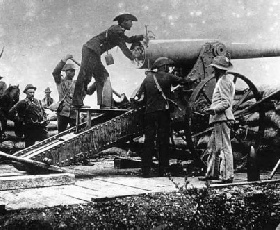
At Kimberley 4,000 Boers hemmed in 500 British troops and 50,000 civilians. The British commander was Colonel Kekewich but the dominant person in the town was Cecil Rhodes. Apart from his 500 regulars Kekewich had the use of the town guard of 3,500 civilians and the facilities and arsenal (450 guns) of the De Beers operation that was able to manufacture ammunition in its workshops. Here the garrison was not idle and made a number of sorties against the Boers. Kimberley was never in any danger of being taken as there were no surrounding kopjes as at Ladysmith. It was just a case of waiting for the arrival of Methuen's forces from the south. The mining operations helped the town in several ways-
Mafeking
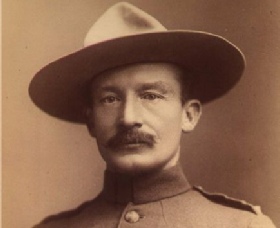
At Mafeking 8.000 men and 12 siege guns under General Cronje surrounded the town under the command of Robert Baden Powell who had 745 soldiers under his command and 450 volunteers. The Boers had 10 modern pieces of artillery including a 94 pounder Creusot. Makeking was a small border town of 1500 white inhabitants (and 5000 villages of native Barolong and Fingo outside the town) at the junction of three territories and the railway from Cape Colony to Rhodesia passed through the town. It became a symbolic siege without much strategic importance. It lay just ten miles from the Transvaal border so supplying the besieging forces was not a problem. It was also from here that the Jameson raid of 1895 had started giving the town additional symbolic importance. The town though had been ignored by the Cape authorities and had few defences. It had a small white population and was too remote to be defended. Eventually the town authorities persuaded Baden-
The Mafeking defences stretched in a five mile perimeter around these populations and consisted of hastily constructed forts. With so little trained troops Baden-
Within the town Baden-
The siege was conducted on gentlemanly lines with no fighting on the Sabbath, and no firing on the convent, the Victoria Hospital, the mule powered ambulance or the camp established the town for women and children. When these conditions were broken there was lengthy correspondence between Baden-
Baden-
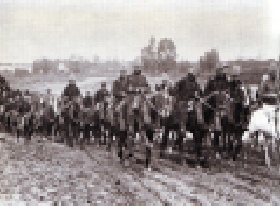
The British retreat to Ladysmith
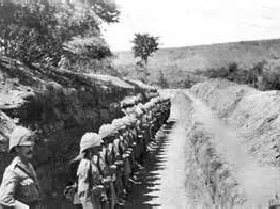
British troops defend Ladysmith
A Long Tom at Kimberley
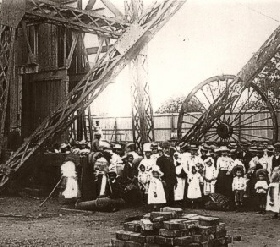
Women and Children took shelter down a mine shaft in Kimberley
Baden Powell commanded the forces defending Mafeking
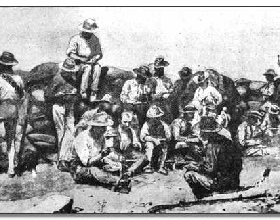
British Defenders at Mafeking