1815-1914

Why did Britain go to war against Germany on August 4, 1914? Part 2

The end of ‘splendid isolation’
The government was keen to try and resolve differences over Morocco, Newfoundland and Egypt with France and over the Far east and central Asia with Russia. Little came of efforts to come to an arrangement with Russia but in 1902 Britain did sign a treaty with Japan by which both countries agreed to follow an Open Door policy with regard to China, to remain neutral if attacked by a third country and to come to each other's aid if attacked by tow or more powers.
Following the visit of the Edward VII to Paris in 1903 the way was open for a treaty with France which was signed in 1904 and agreements were made to settle outstanding differences over Egypt and Morocco. With the weakness of Russia's position made clear following its defeat by Japan in 1904-
Foreign policy was in the hands of one man, Edward Grey
The direction of foreign policy in the years leading to the outbreak of war was largely in the hands of SIr Edward Grey. He didn't have to worry about interventions from either Edward VII or George V whilst the Prime Minister trusted Grey enough to allow him to determine his own policy so long as it accorded with his own. Grey had around him at the Foreign Office a group of like minded civil servants -
Grey dealt with criticism by ensuring that his opponents were given as little information as possible. his was a personal diplomacy and consultation was on the basis of 'a need to know' and Cabinet was not informed about some crucial decisions such as the discussions in 1905-
Such a policy which might seem consistent to those who had Grey's ear could appear anything but consistent to those on the outside. To the Germans it must have seemed that Britain would stand aside from a continental coalition, especially if the Franco-
Grey although Foreign Secretary knew very little about the countries he was dealing with. He spoke no foreign languages and did little travelling. His view of the world moreover was opposed by many Liberals and supported by most Conservatives. He was a Liberal Imperialist although he cared little for the British Empire. His views and actions were largely focused on Europe and largely around the various treaties which had been signed and to which he remained committed where they concerned Britain.
Looking back at Anglo-
British and German were not obvious enemies
Both nations were Teutonic races sharing the same sober values and in both countries the Protestant elites dominated. Each found much to admire about the other. The British admired German culture and science, and British medical students had to study German as all the manuals on medicine that they used were German. The Germans admired Shakespeare and the British way of life. There were many personal links and of course the royal families were linked with Victoria descended from two German families -
From the time of German's emergence as a independent state in 1871, German developed its economy steadily. In 1880 Germany had just 8% of the world's manufacturing production to Britain's 22% but by 1913 had 14% to Britain's 13%. This though need not have been a cause for conflict as they were trading partners and had a mutual reliance. Whilst Germany consolidated its economy Bismarck developed a series of treaties to ensure German's security. He constructed a number of contradictory agreements with neighbouring powers that guaranteed German's security as long as Germany did not get involved in colonial matters which was causing the tension between the likes of France, Russia and Britain. Once William became king though in 1888 and began to take a hold over the German government this all changed. In 1890 Bismarck left the government and this coincided with Germany not renewing the Reinsurance Treaty with Russia. Germany now embarked on a new course in foreign policy, largely initiated by Friedrich von Holstein in the Foreign Ministry.
An ‘empire in the sun’ was all the talk in Germany
William, his government ministers and advisers now began to talk of a German empire. There was vague talk of 'Weltpolitik' and 'An Empire in the sun', vague concepts that were never clearly defined but caused consternation amongst imperial rivals. The Imperial powers often used their colonies as bargaining chips and Germany's inability to do this marked her out as a second rate power and there were times when foreign diplomats treated her as such. All the time that Germany remained without an Empire, it would not get involved in the kind of disputes that caused tension between Britain and France, Russia and Japan and Russia and Britain. If Germany were to look to acquire an Empire it could not avoid getting involved in disputes with all of these
With the failure of Germany to renew the Reinsurance Treaty with Russia and Russia's signing of a defensive treaty with France, Germany seemed to be hemmed in. Holstein wanted a closer relationship with Austria with whom Bismarck had forged a treaty of alliance in 1879
Anglo-
Germany began in the 1890s to look for colonies and to acquire interests abroad. With Tirpitz winning the factional battle within the naval administration, he pressed for a programme of battleship construction which began following the Naval Acts of 1898. The development of an enhanced navy has been given as a major cause of the war yet Germany believed that it would not be taken seriously until it had a larger navy. It wasn't the building of a German navy that forced Britain into an alliance with France and Russia but Britain's need to resolve outstanding colonial issues with these countries. In the end Germany renounced the naval race in 1913 by which time Germany had not got even close to Tirpitz's aim of a German battleship for every 1.5 British battleships. By 1914 Britain had 29 large naval ships to German's 17 and Britain's lead over Germany was increasing by every year that went by.
The same could be said of German's desire of a 'Place in the Sun', the establishment of a German empire. By 1914 Germany acquired the Mariana and Caroline islands, Samoa and Kiaochow on the Chinese coast -
Who determined foreign policy in Germany?
The exact direction of German foreign policy was difficult to discern and her talk of establishing an empire and navy to rival Britain's was all bluster but talk that made it easy for newspapers and writers to portray Germany as the major threat to Britain and her empire. Had there been a clearer direction it would have been easier to avoid war in 1914 but much the same could be said of most of the European powers. We have already seen how Grey conducted his own foreign policy much of it secret and the same could be said of Germany where the Kaiser was full of rhetoric about war but really wanted peace to prevail.
William in his time as Kaiser of Germany demonstrated all the insecurities and lack of conviction that an emerging power like Germany would exhibit as it sought to establish itself as a major power among European nations. Germany was keen to establish itself as the major power in central Europe, where there had not been a great power for centuries. It was over sensitive to how foreign diplomats dealt with it and in particular to what it saw as its being encircled by the agreements signed between Russia and France.
The Kaiser reflected these sensibilities and made things worse by his own tendency to talk too much and constantly make up schemes and plans which he tried to foster on others. He was forever, in memos, telegrams and letters ranting on about his own pet schemes which were dreamt up quickly and as quickly forgotten such as the scheme to station a corps of Prussian troops on the Californian coast to help protect the USA against Japan.
William appointed all his own officials and often by-
If William himself did not determine foreign policy, then who did? It was not the king and it was not even the Foreign Minister as Germany lacked such a person. Instead there was an imperial state secretary for foreign affairs who was the direct subordinate of the Chancellor. Decision making on foreign affairs vacillated between power-
The crucial event in this process had been the lapse of the Reinsurance Treaty between Russia and Germany in 1890. France and Russia both saw Germany as a potential enemy and decided to conclude a defensive alliance which was ratified in 1894. In 1904 Britain signed an Entente with France. Whilst it was not a defensive treaty Britain had now aligned herself with France and with the close links that developed, particularly over military and naval cooperation, Britain felt honour bound to support France in 1914.
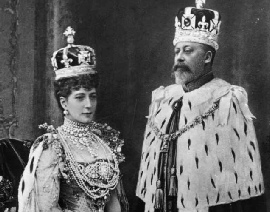
Edward VII and Alexandra
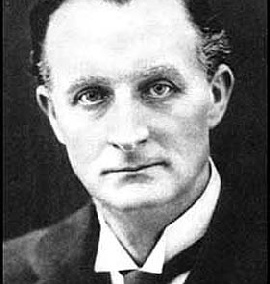
Sir Edward Grey
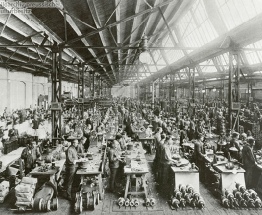
German industry rivalled British industry by 1914
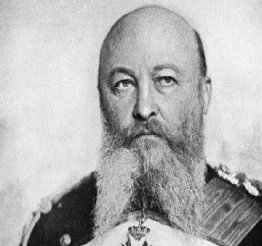
Alfred von Tirpitz, the architect of the German navy pre-
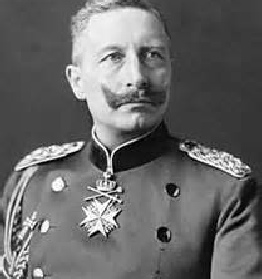
William II of Germany